
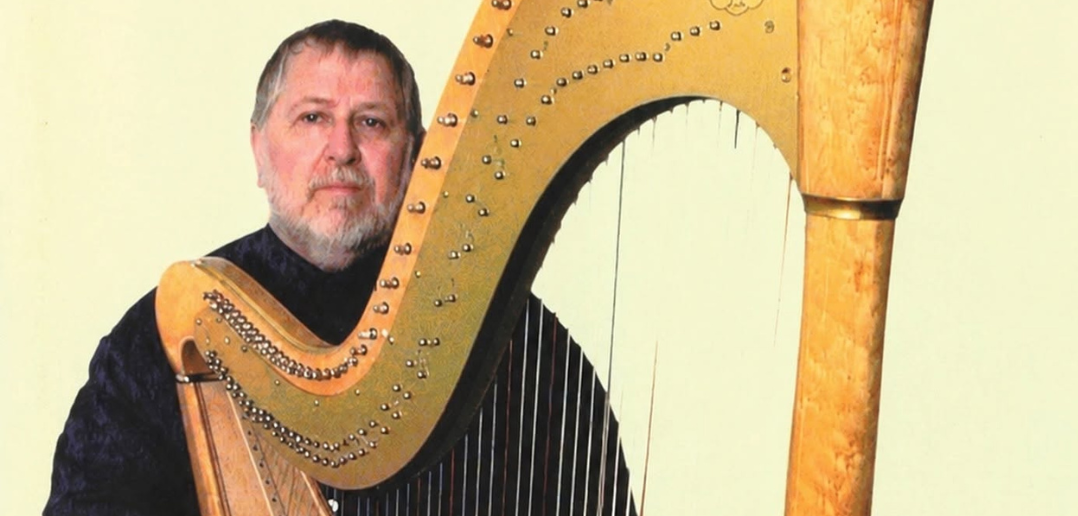
French composer and harpist Bernard Andrès died on July 14, 2026, at the age of 84. Born in 1941 in Belfort, France, Andrès discovered the harp at age 19 and studied at conservatories in Besançon and Strasbourg before entering the Paris Conservatory, where he won a first prize in harp in 1966.
Andrès was an innovative composer who developed his own notation for a range of extended techniques. His compositions include many works for the harp at varying skill levels and compositions for orchestra and for different chamber music ensembles.
On his legacy for harpists, Audrey Perrin and Isabelle Perrin shared the following tribute:
“It is difficult to summarize in a few words the life and career of Bernard Andrès, who has just passed away. Inspired by Lily Laskine, who premiered his Concerto Tiento per Pablo, he was the composer who wrote more for the harp than anyone else, at every level—from beginner to concert soloist. He also composed for various instruments: trumpet, violin, cello, flute, oboe, bassoon, wind orchestra, and choir.
“Having begun his instrumental training on piano (his first compositions were written at age 8), he started the harp at 19. Quickly he entered the class of Jacqueline Borot at the Paris Conservatory, before joining the Air Force Music Orchestra and then the Philharmonic Orchestra of Radio France [from 1969 to 2005]. He also taught for many years and collaborated with his wife, Marie Laheurte, who wrote texts that Bernard Andrès set to music.
“Some of his notable quotes include:
‘Composing has always been something natural and spontaneous for me. It wasn’t a reasoned choice—it was a necessity.’
‘My only passion has always been music. I believe I fell into its cauldron even before my birth.’
‘Composition has always been the center and meaning of my life, all the more so because it is entirely intuitive and not intellectual.’
‘What more could I say that wouldn’t be mere sterile chatter?’
‘The first piece of advice that comes to mind is to work your instrument intelligently. Not in a repetitive way: you must think and constantly seek to improve your practice through concentration. It’s not the quantity of work you should aim for, but its quality. Having heard many harpists in my life, I must say that very few have interested me or touched me in any way. Too many seek speed or force at the expense of beauty, tone, and musicality. Could this be to hide the absence of music in their souls?’”
—Audrey Perrin and Isabelle Perrin
Audrey Perrin had the good fortune to be his student for six years. Many manuscripts remain unpublished, and Bernard Andrès entrusted her with keeping this legacy alive so that harpists can benefit from his latest works.
Isabelle Perrin was Bernard Andrès’ colleague for many years at Radio France. He entrusted her with recording the first album entirely dedicated to his works and composed for her the Danses d’Erzulie for harp and string orchestra.
Ed.—Check back for details about an online resource Audrey Perrin is developing to access Andrès’ previously unpublished works. Learn more in our cover interview with Andrès from the March-April 2001 issue of Harp Column.