

Read our interviews with First Prize winner Lenka Petrovic and Second Prize winner Joel von Lerber also in this issue.
Harp Column: Congratulations for winning the third prize in the 2018 International Harp Contest in Israel! The harp community in Israel is quite small, and we don’t always have a local harpist in the contest. It was very exciting for Israelis to follow you all the way to the final stage. Many of us think that you deserve an additional special prize for competing in the contest while being the mother of an infant. How did you find the time and energy to prepare for the contest?
Marina Fradin: Thank you. As soon as they had announced the repertoire for the 2018 contest, I started working. Almost all Israeli harpists dream of competing in the International Harp Contest in Israel, and it has always been a goal of mine. I was sure that this would be my last chance to be in the contest before passing the age limit. I had already learned the music for the first stage when I became pregnant. All my priorities changed overnight. The contest was no longer my main focus. I decided to compete for myself, and I really took it on as my own personal challenge. I believe this approach helped me compete. I didn’t feel the pressure to win and was able to be more relaxed and focus on giving my best possible performance. If I missed a pedal or made a mistake, it didn’t destroy me. Many of the other harpists were very nervous and performing under a huge amount of pressure. I didn’t have this handicap. In the end, one of the reasons for my success was because I had a small child. My daughter will turn 1 year old in December. She has been listening to the contest repertoire all of her life. But I don’t think she really liked the modern repertoire in the second stage because of the way she moved and kicked while I was still pregnant. [Laughs]
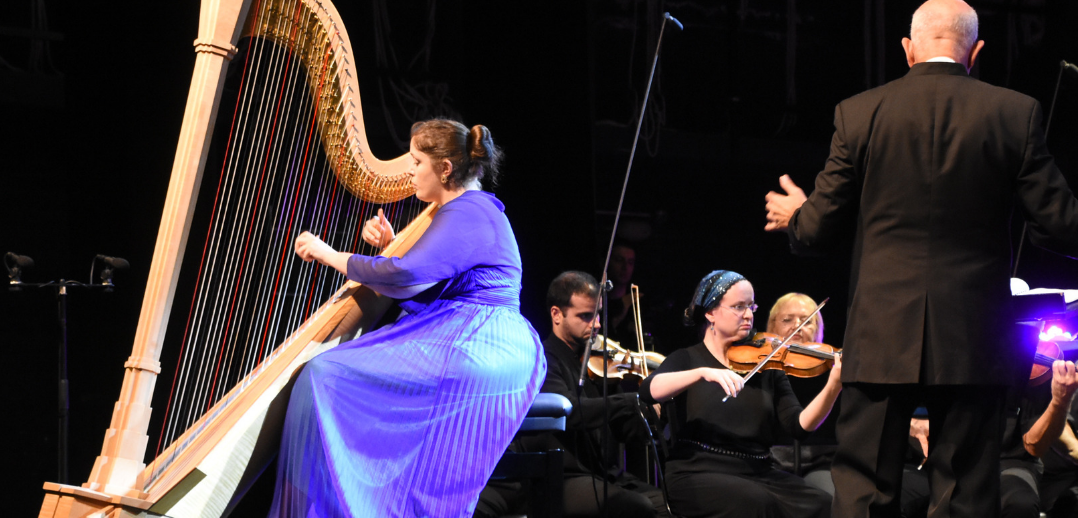
HC: You have been the principal harpist of the Jerusalem Symphony since 2011. [Ed. Author Sunita Staneslow also served as principal harpist of the Jerusalem Symphony from 1985–1986.] As a young mother and harpist with a major symphony, how did you find time to prepare for the contest?
MF: The harp is not in every concert during the season. With the exception of a one-week tour and a few other concerts, I didn’t perform with the symphony in July and August. The Jewish High Holidays were celebrated in September this year. I had the opportunity to focus on preparing and practicing while most Israelis were on vacation. The timing worked out well for me. It was a bit more difficult balancing practice time with a young baby. I practiced only the Chertok and Flagello while I was pregnant. I was only able to start preparing the modern Israeli works in March of 2018. My daughter didn’t want to let me play the piece by Brener. The buzzing bass effects scared her and she would start crying. When she started daycare in May, it became much easier to work.
HC: Tell us more about your background. You have officially entered the world stage, and we would like to learn more about you.
MF: I come from a musical family. Both of my parents are professional pianists. I am fortunate to have studied with great teachers from the very beginning. I grew up in St. Petersburg, which has a world-renowned harp school: The Secondary Special Music School of the St. Petersburg State Conservatory named after N.A. Rimsky-Korsakov (SSMSH). In 1995, at the age of 7, I began my harp studies with Karina Maleeva and Prof. A.Varosyan. To give you an example of the high level of the harp in St. Petersburg, Sasha Boldachev studied at the same harp school just three grades below me. Alisa Sadikova, who also competed in the contest this year, currently studies with Karina Maleeva. Julia Rovinsky, principal harpist with the Israel Philharmonic Orchestra and Music Director of the International Harp Contest in Israel also studied at the SSMSH.
In 2003, I was 15 years old and immigrated to Israel with my mother, while my father and brother stayed in Russia. My parents were divorced, and my brother was in the middle of medical school and didn’t want to change languages. My mother knew that moving to Israel would give me more opportunities as a harpist, and I also had the opportunity to study with Julia Rovinsky. Today we are both colleagues and friends.
HC: What might other harpists learn from your experience?
MF: Most harpists competing are in their early 20s. Many are still studying. I want to encourage more harpists to compete at a later age. This will bring a maturity of musicianship to the contest. The Israeli Harp Contest is a huge challenge because you need to play many styles well. Experience working with a wide range of styles is important. You also need to perform with a chamber group and an orchestra in the final stages. There are beautiful harpists out there who have just started both their careers and their families and are reluctant to compete. I am 30 years old and competed with an infant and a full time symphony career. I admit that it was much easier for me because I live in Israel. I understand the difficulty of putting your life and career on hold for a few weeks, but I encourage all harpists to compete. I hope that I can inspire a few young mothers to come to Israel. •