
9/10
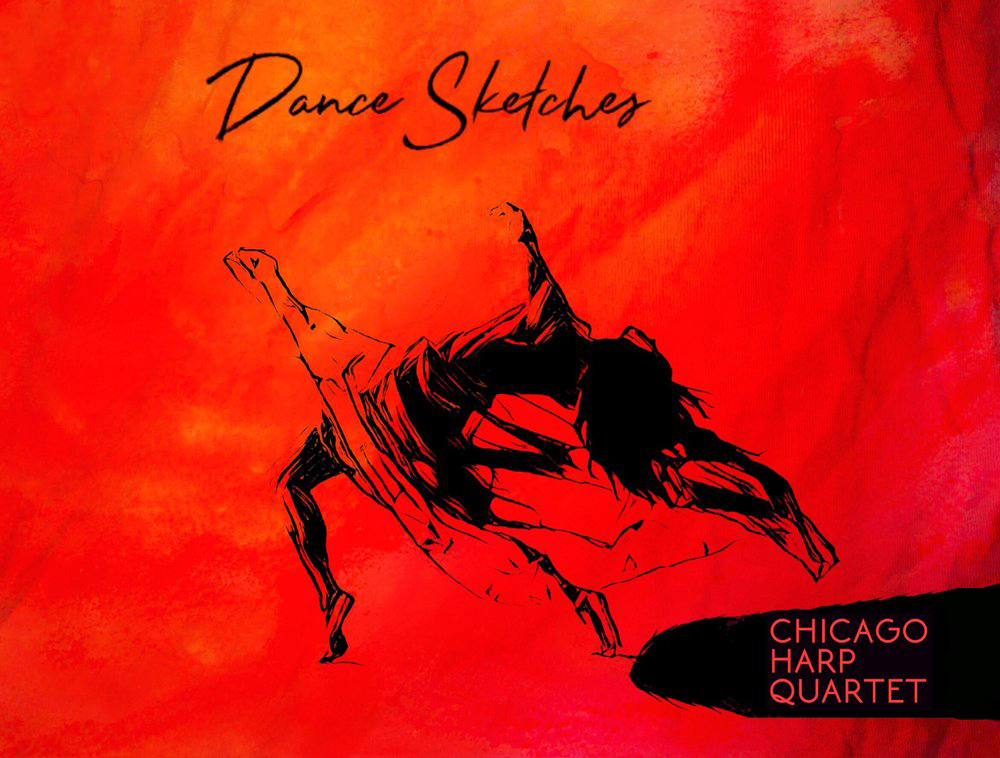
Chicago Harp Quartet: Emily Granger, Catherine Yom Litaker, Julie Spring, and Marguerite Lynn Williams. Self-released, 2018.
I have never been quite sold on harp quartets, the idea that just because something is additive it’s necessarily and automatically a bonus. But in this most recent CD Dance Sketches with the Chicago Harp Quartet, I’ve been won over.
It’s a combination of the virtuosity of the individual players—Marguerite Lynn Williams, Julie Spring, Catherine Yom Litaker, and Emily Ann Granger—and the fiery conversation they have as a group that grabs from the first notes. They open with “Spanish Dance” from La Vida Breve by Manuel de Falla that is light in its shoes, gracefully gliding along the dance floor with perfectly timed ease.
This leads us to a new work to my ears, a piece composed in 2016 by English composer Richard Bissill who says that he had Thomas Hardy in mind when writing his Dance Sketches. Like a dance around a Maypole by village girls in white, the cascading lines in varied rhythms as played by CHQ feel as if a slight breeze has billowed out those white dresses. Swagger infuses both the jazzy waltz and the heated-up tango, which CHQ milks for all its worth. You can’t help but begin dancing yourself.
All the stops are out for Paul Patterson’s Avian Arabesques. Stunningly conceived for harp quartet, this is no mere transcription that offers everyone a chance to play at least something, there is more of the orchestral in it, which offers CHQ a chance to really show what they’re made of, particularly in “Legend of Anka,” which exploits the rich and contrasting palette available to the harp.
Utterly beautiful is Cuban Dream After a Storm by Cuban harpist Alfredo Rolando Ortiz. Written for the quartet, its inspiration was childhood memories of tropical thunderstorms that led to nocturnal thoughts of danzon. CHQ gives the work just the right impressionistic feel of dreaminess combined with tropical sizzle.
Bruce Broughton’s quartet is a particular favorite—especially the sentiment. The title—Dancing for Love, Dancing for the Gods—is taken from a comment by Isadore Duncan that the dancers at the Paris Opera do not dance for love, or for the gods. There’s an insistent quality to this music, forcing us to stay with the ensemble to see what magic they might create. Angular and not always heading where you expect, the set of three dances with only tempo markings as code to how they should be executed, CHQ makes this the most gripping and symphonic of the repertoire on the disc.
The final work on the disc is an arrangement by CHQ member Marguerite Lynn Williams of Liszt’s exalted Hungarian Rhapsody No. 2. I was a little skeptical going in, but her arrangement is terrific, maintaining the gravitas, the explosive virtuosity, and the unabashed athleticism.