

10/10
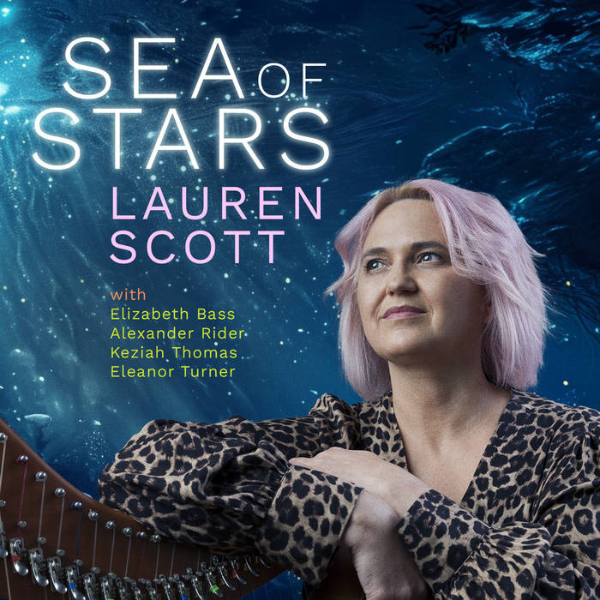
Lauren Scott, harp; with Elizabeth Bass, Alexander Rider, Eleanor Turner, and Keziah Thomas, harps.
Self-released, 2024.
Inspired by fantastical bioluminescent glow-in-the-dark creatures of the ocean, Lauren Scott’s vibrantly colored album Sea of Stars is a joyous exaltation. Her radiant tone, exacting technique, and boundless imagination prove ideal for this breathtaking collection of originals and works by like-minded others she calls her own “personal sea of stars.”
Right away with the title track, Scott invites us to revel in the marked differences in pedal and lever harps, playing a duet with herself. Her bubbly music shimmers and hums in a dazzling display. I swear I can see phosphorescence just by listening. From the ocean we go to land with Alex Rider’s dance-like Printemps. Scott presents it as an explosion of spring itself after a period of darkness.
In Grace-Evangeline Mason’s Glass Cathedrals, Scott makes use of fragile extended techniques like murmuring bisbigliandi along stolid plaqué chords that conjure images of immensity, even if ephemeral and dying away. It’s absolute magic. Likewise, Scott leans into the subtle mystery of Rüdiger Oppermann’s Breathing For Harp, allowing space for the inherent meditativeness.
Composer and harpist Keziah Thomas joins Scott in her On a Blue Hill. Envision the two gazing up at the sky and commenting on four types of clouds as they slowly come into view. In sharp contrast is the jazz-infused No One Can Stop Me Now by Monika Stadler. Written for prepared harp, it’s an upbeat study in buzzy, clangy percussion that will have you grooving.
Also for prepared harp, three talented musicians, Elizabeth Bass, Alexander Rider, and Eleanor Turner, join Scott in her tour de force The Sun and Her Flowers. With paper woven between the strings, the harps sound like a Kalimba finger-piano quartet.
Scott’s special talent is in evoking movement through awe-inspiring scenery, setting us on a journey through sound. She does this by emphasizing the legato phrase, even when the sound of a plucked string inevitably dies away. Her rendition of the “Prelude” from Bach’s Suite for Cello is the most illustrative. She quite bravely takes on a single-voiced melody, sidestepping the harp’s ability to provide harmony. There’s something risky yet confident as she ventures out on this tightrope, luring us to a sleight-of-hand where the phrase feels as if sung.
One of my favorites is Scott’s complex duet arrangement of Ravel’s “Laideronette, Empress of the Pagodas”from the Mother Goose Suite. Shimmery and sparkling, it epitomizes the sheer wonder of this arresting collection.