
Words of wisdom
Scroll down for advice and suggestions to keep you on the right track as you explore etudes.
Eat your vegetables. Brush your teeth. Practice your etudes. The things we know we should do every day aren’t necessarily the things we want to do every day. Like most good habits, daily etude practice is not glamorous or fun. It takes patience and discipline, and there is no instant gratification. It can often feel like a pointless endeavor. Quite a sales pitch, eh?
Any music teacher will tell you: etude study is effective if done consistently and thoroughly. Since the payoff doesn’t come quickly, many struggle to commit to them long term. You can imagine our surprise when nearly 1,000 harpists committed to daily etude study in Harp Column’s annual 30 Day Practice Challenge in January. Our theme this year was etudes, and we challenged harpists to practice an etude every day for 20 minutes for the first 30 days of the year. Some participants worked on an etude of their choice. Others worked on the daily etudes that we suggested, which covered five areas: arpeggios, scales, harmonics, rhythm, and theory.
If you missed the challenge in January or just want a project for summer vacation, we’ve included the highlights here. Most (but not all) of the etude examples are available free on the IMSLP website, and there are additional resources available on our 30 Day Practice Challenge page. Check it out and join us in 2024!
(Click an image to enlarge an excerpt of etudes marked with a *)
Arpeggios
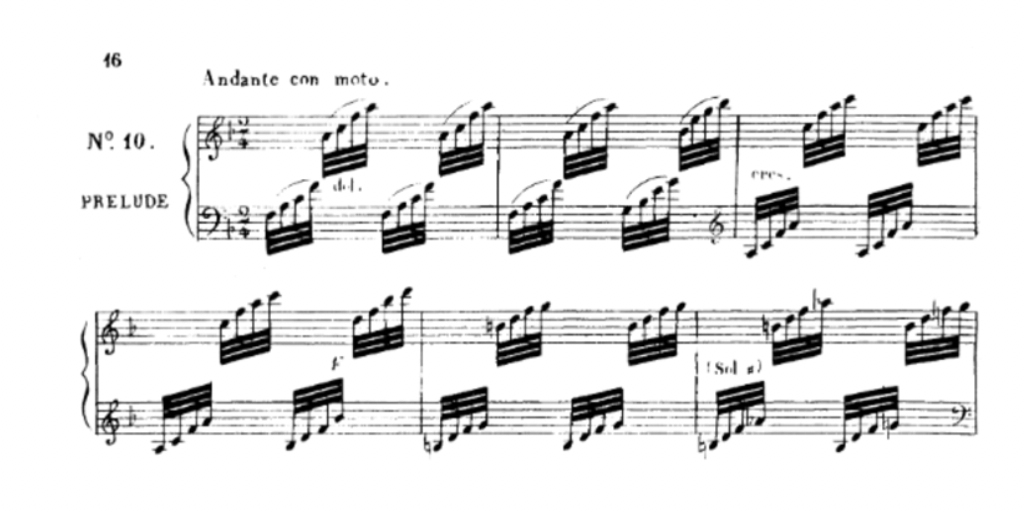
*30 Etudes Progressives, No. 10 , Louis Concone
The 10th etude in this collection works all four fingers in both hands, helping you achieve flawless ascending arpeggios. Free on IMSLP.
22 Progressive Etudes, No. 24, Johann Friedrich Burgmüller
Johann Friedrich Burgmüller’s etude “The Swallow,” edited by Harp Column Music artist Kaffee Peck, works on arpeggios where the left hand crosses over to take the top note in each phrase. Available for purchase on Harp Column Music.
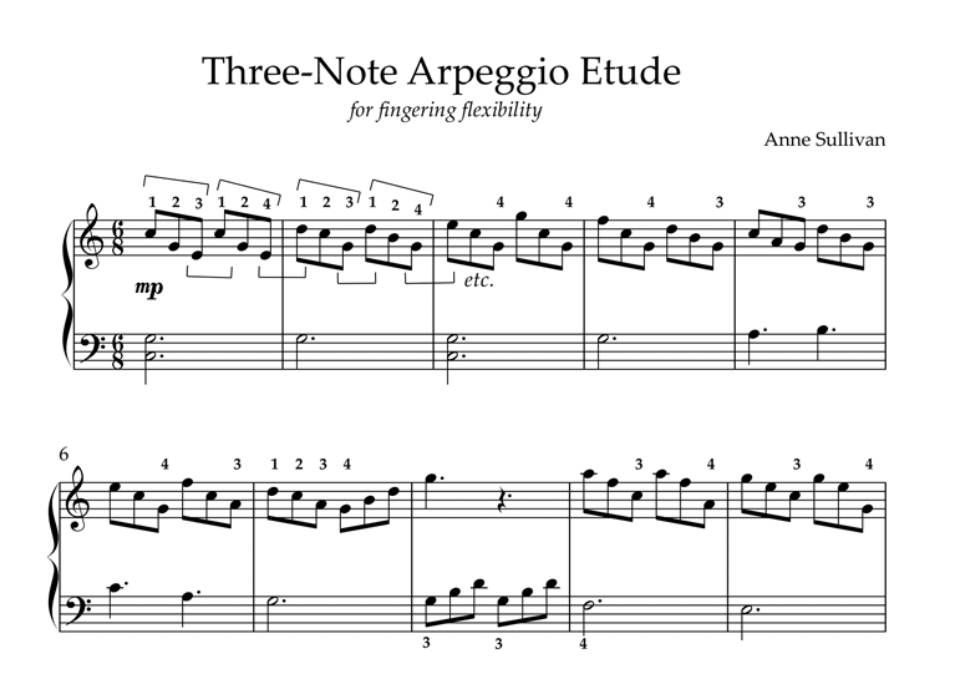
*Three-Note Arpeggio Etude, Anne Sullivan
Composer Anne Sullivan describes this etude as a “study in fingering flexibility, meaning the flexibility to use different finger combinations in sequence and to switch smoothly between them.” Available free in the “Tear-Out Tunes” feature in the January-February 2023 issue of Harp Column.
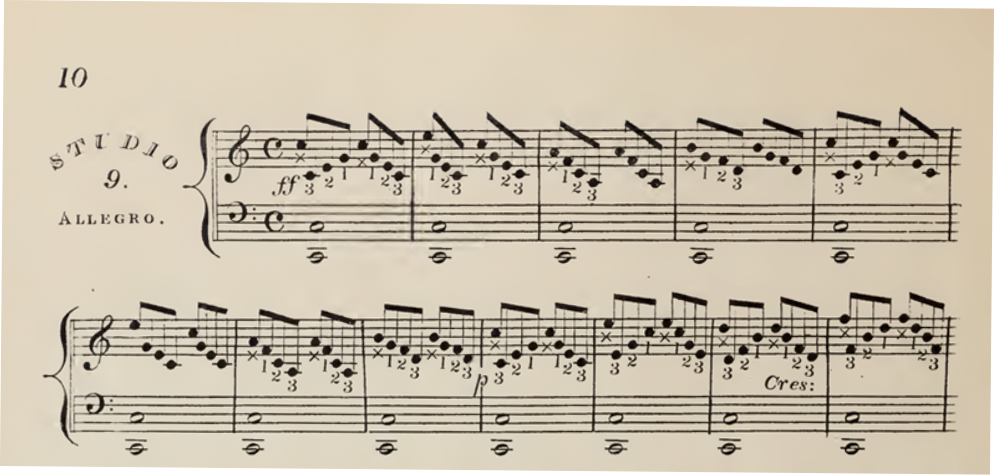
*The Pupil’s Companion for the Harp, No. 9, Nicolas-Charles Bochsa
This etude works on ascending and descending arpeggios in the right hand, making it a great etude to work on directional placing. Free on IMSLP.
Etüden und Präludien für harfe, No. 14, François-Joseph Naderman
Arpeggios that sweep across the entire range of the harp using overlapping hands is the focus of this etude. Free on IMSLP.
40 Progressive Studies for the Harp, No. 14 Nicolas-Charles Bochsa
Composer N.C. Bochsa uses an arpeggiated bass line throughout this etude. This pattern, called Alberti bass, is quite common in harp music, so it’s always good to refresh this skill. Free on IMSLP.
Scales
Twenty-Four Easy Studies for the Harp, No. 6 , Alfred Holý
This etude focuses on eight-note scales in both right hand and left hand. Free on IMSLP.
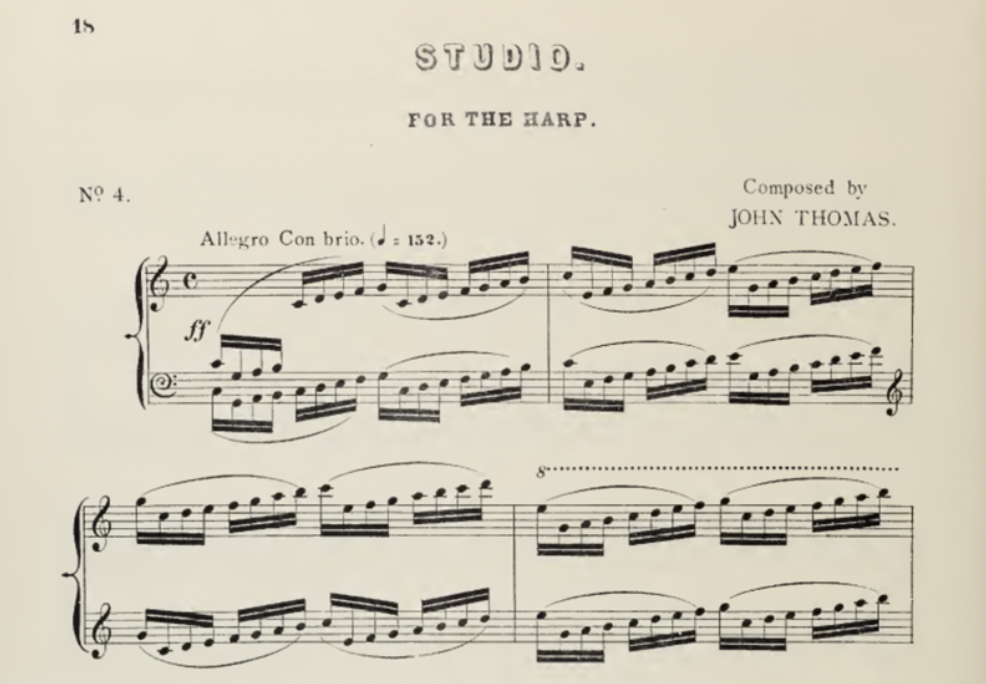
*6 Studies for the Harp, No. 4, John Thomas
John Thomas’ fourth study in this collection works on eight-note scales played in both hands simultaneously, as well as other scalar passages. Free on IMSLP.
Twenty-Four Easy Studies for the Harp, No. 8, Alfred Holý
Develop ascending and descending eight-note scales in this etude. Free on IMSLP.
Bass Clef Etudes, No. 1, Christine Mazza
We can’t neglect our left-hand scale skills. Christine Mazza’s first etude from Bass Clef Etudes strengthens fingers in the left hand with phrases moving in alternating opposite directions. Available for purchase on Harp Column Music.
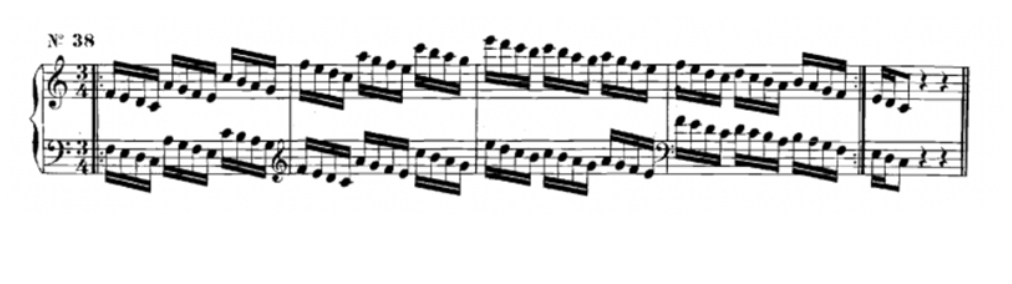
*Exercises et Etudes pour la harpe, No. 38, Edmond Larivière
Edmond Larivière uses scalar phrases that move up and down the harp, requiring the harpist to place up or down to each phrase. Free on IMSLP.
Rhythm
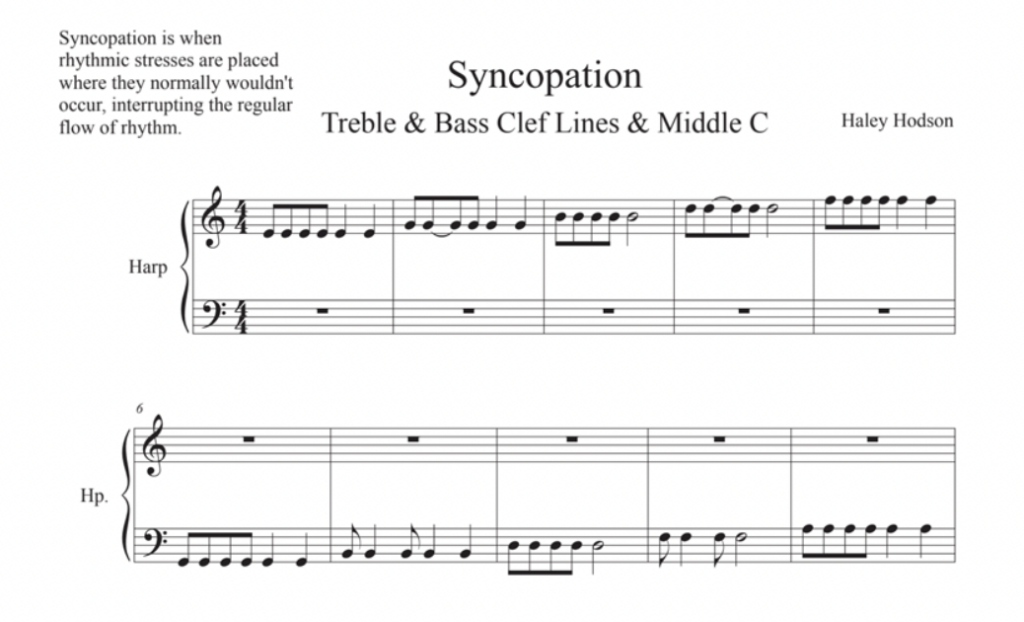
*Learning Notes and Rhythms at the Harp, Syncopation, Haley Hodson
Haley Hodson’s etude “Syncopation” is a great beginning step to learning rhythm. It works on learning half-note, quarter-note, and eighth-note rhythms. Available for purchase on Harp Column Music.
Etude Impromptu Op. 37, Luigi Maurizio Tedeschi
Does playing in 6/8 time feel uncomfortable to you? It won’t after learning this etude. For beginners, try clapping out the melody rhythm of the first few lines. Remember, a dotted quarter note in 6/8 equals three beats. Free on IMSLP.
An Introduction to Jazz, Play It Again, Amanda Whiting
Amanda Whiting’s fun etude “Play It Again” is inspired by funk music. It works on syncopated rhythms and swung eighth notes. Available for purchase on Harp Column Music.
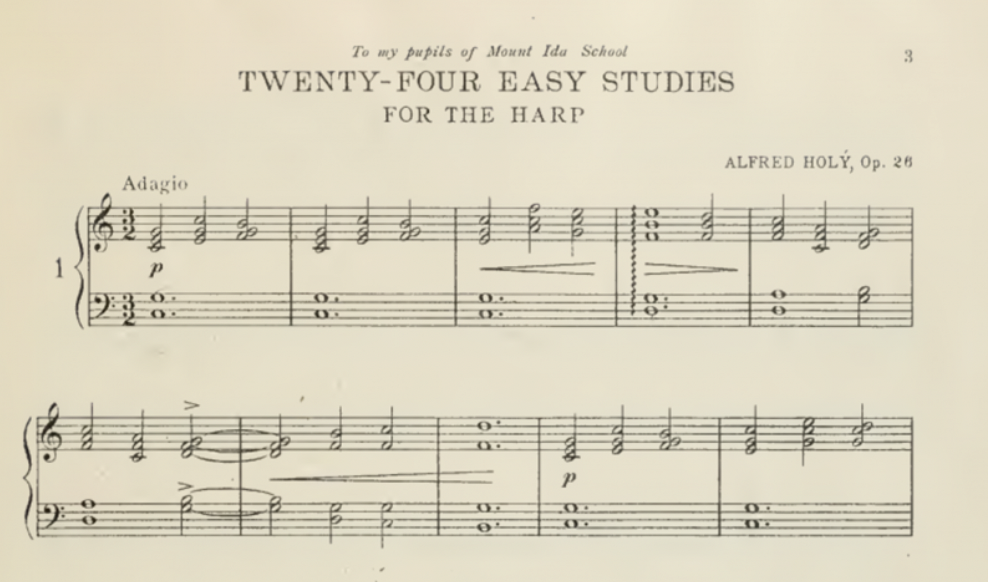
*Twenty-Four Easy Studies for the Harp, No. 1, Alfred Holý
The first etude in this collection works on half notes. Set your metronome and try rolling the chords with the top note of each chord falling right on the beat. Free on IMSLP.
50 Études Op. 34, No. 13, Nicolas-Charles Bochsa
Get better acquainted with various rhythms in the 13th etude from this popular Bochsa collection. Free on IMSLP.
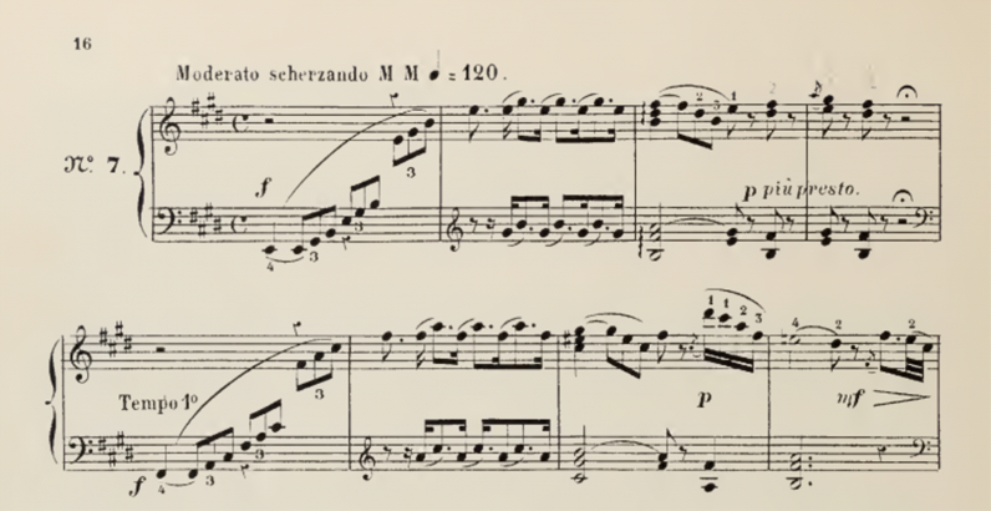
*48 Etudes pour la harpe, No. 7, Dizi/Hasselmans
The seventh etude from this collection by François Joseph Dizi and Alphonse Hasselmans is chock-full of different rhythms: triplets, 16th notes, dotted eighth notes, you name it. It is sure to give you a rhythm workout. Free on IMSLP.
Harmonics
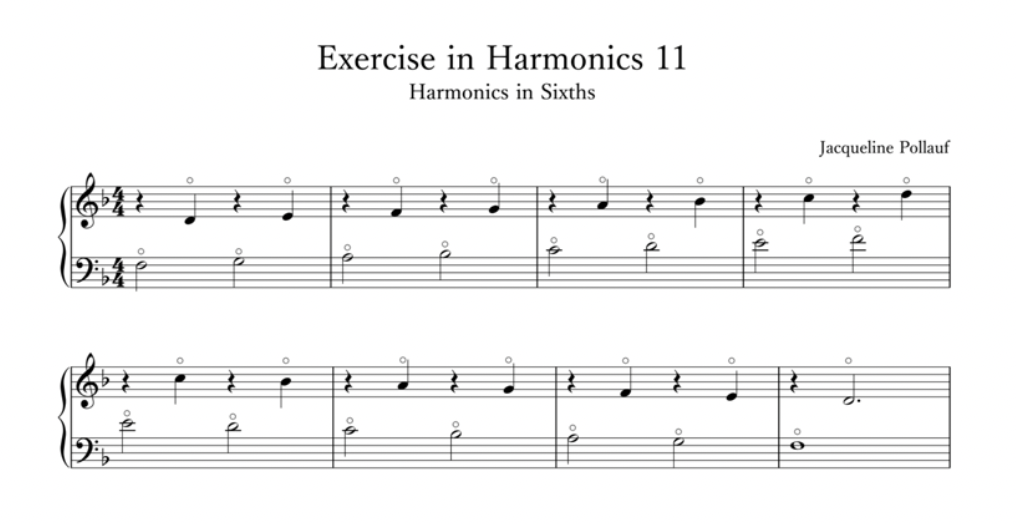
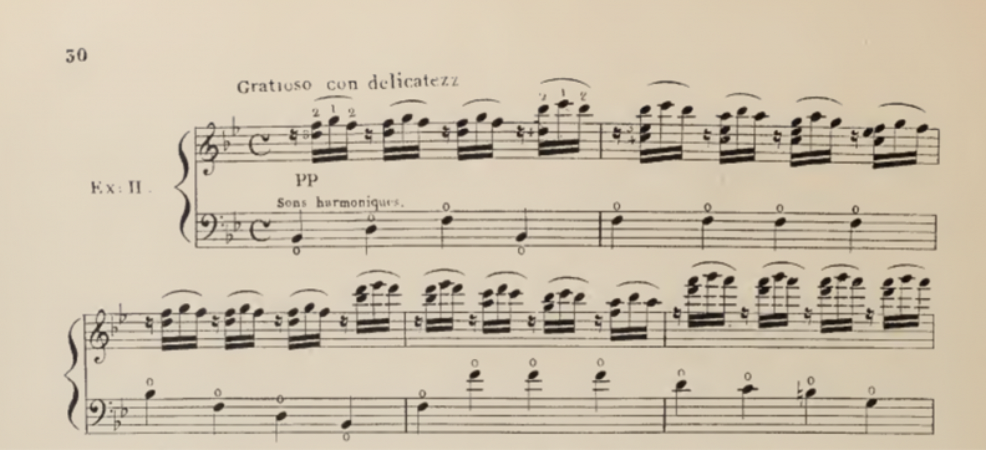
*Exercises in Harmonics: Overtones for the Lever Harp, No. 11, Jacqueline Pollauf
This selection from Exercises in Harmonics: Overtones for the Lever Harp focuses on harmonics in alternating hands. Available for purchase on Harp Column Music.
*50 Études Op. 34, No. 11, Nicolas-Charles Bochsa
This Bochsa etude works on both single, left-hand harmonics and double harmonics in thirds. Free on IMSLP.
Method for the Harp, Cortège, Carlos Salzedo
“Cortège” by Carlos Salzedo is a colorful concert study that uses harmonics in both hands. Each harmonic passage moves swiftly, working on your accuracy. Available from your favorite harp retailer.
Exercises in Harmonics: Overtones for the Lever Harp, No. 17, Jacqueline Pollauf
This etude features harmonics in alternating hands that cross over one another. It is sure to help with finger placement accuracy. Available on Harp Column Music.
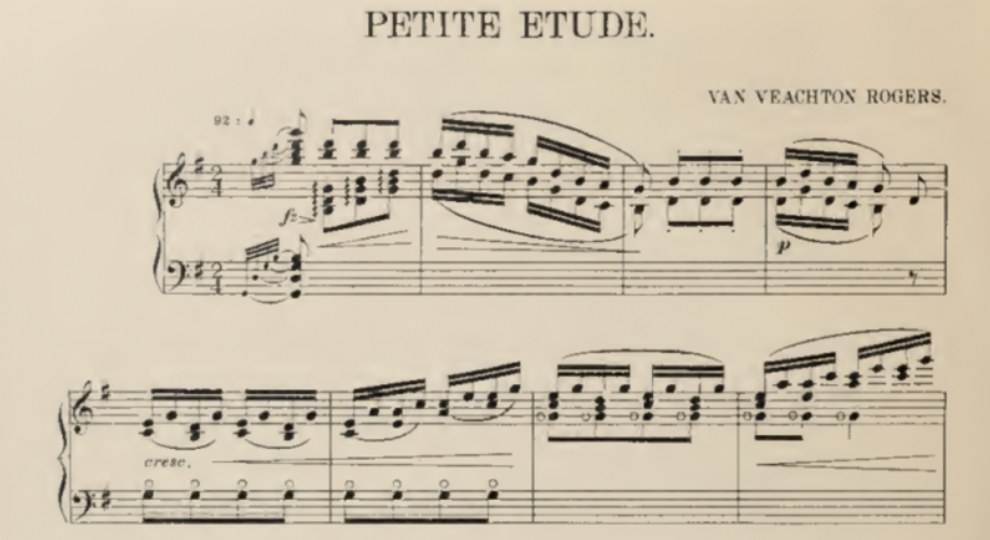
*Petite Etude, Van Veachton Rogers
The harmonics in this sweet little work add extra sparkle to the music. It is a great beginner solo piece that uses harmonics on only five strings in the left hand. Free on IMSLP.
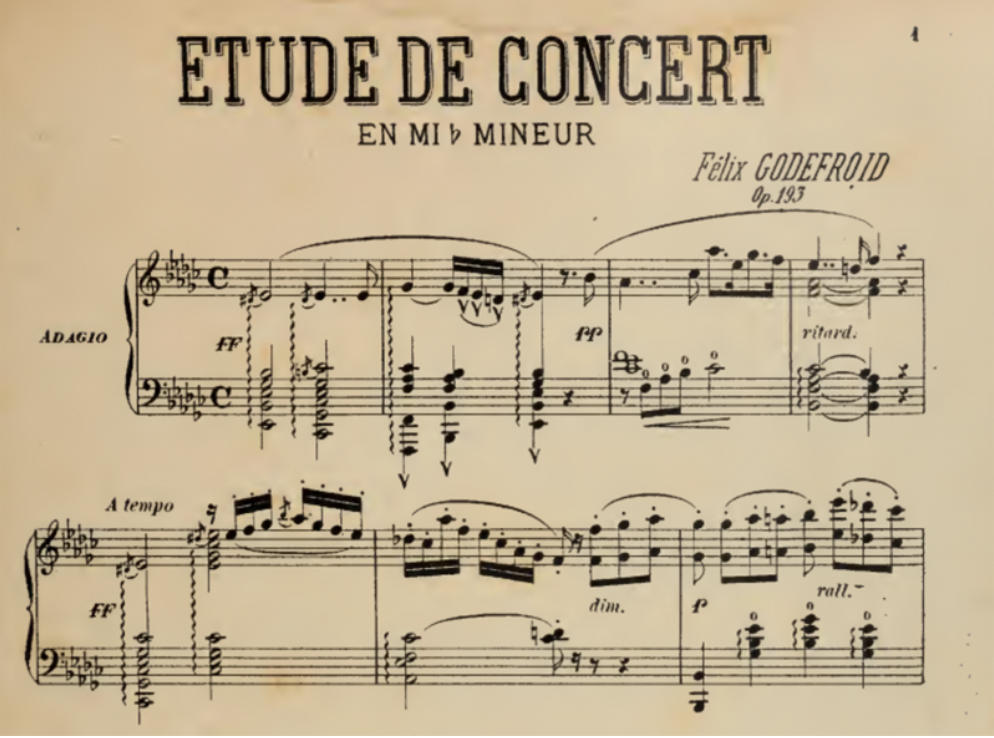
*Etude de Concert, Félix Godefroid
This beloved work in the advanced harp repertoire features plentiful left-hand harmonics throughout, and it even includes some rolled, three-note, left-hand chords that end with a harmonic on top. Free on IMSLP.
Theory
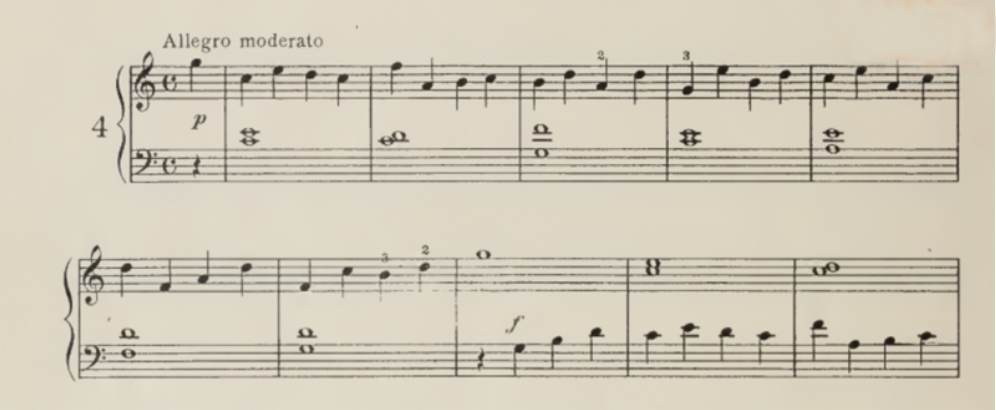
*Twenty-Four Easy Studies for the Harp, No. 4, Alfred Holý
The melody line in this etude has different intervals throughout. Try identifying the intervals between the notes. For instance: from the first G down to C is a fifth. More advanced players can identify the notes using solfège and try sight-singing the melody! Free on IMSLP.
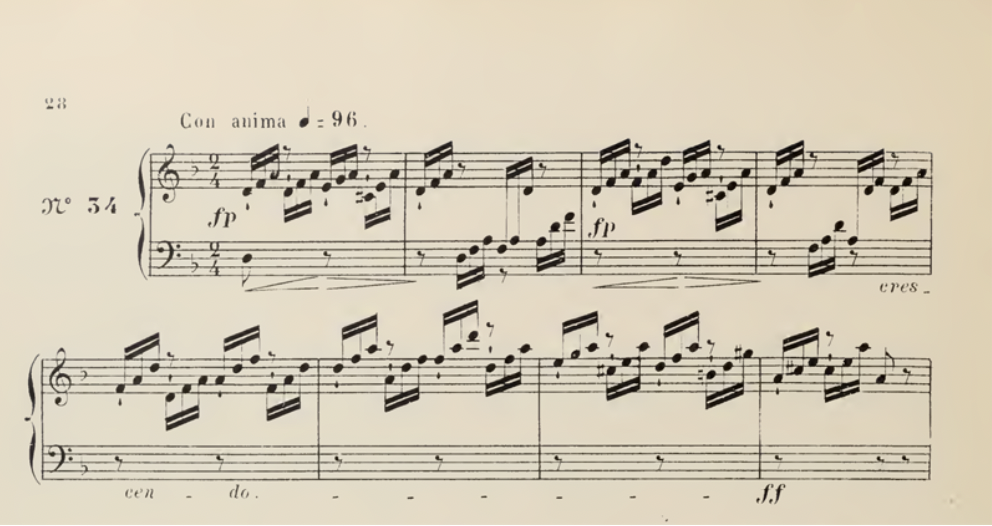
*48 Etudes pour la harpe, No. 34, Dizi/Hasselmans
Try to identify if the triads used in this etude are in root position, first inversion, or second inversion. Free on IMSLP.
Etüden und Präludien für harfe, No. 18, François-Joseph Naderman
There is a key change in this etude. Try to identify the two keys used. Free on IMSLP.
The Harmonic Circle, No. 1, Nicholas-Charles Bochsa
The harmonic circle is a staple theory concept to learn. Play through a few key modulations in this Bochsa work. Free on IMSLP.
*Cool and Groovy Rhythms, Verlene Schermer
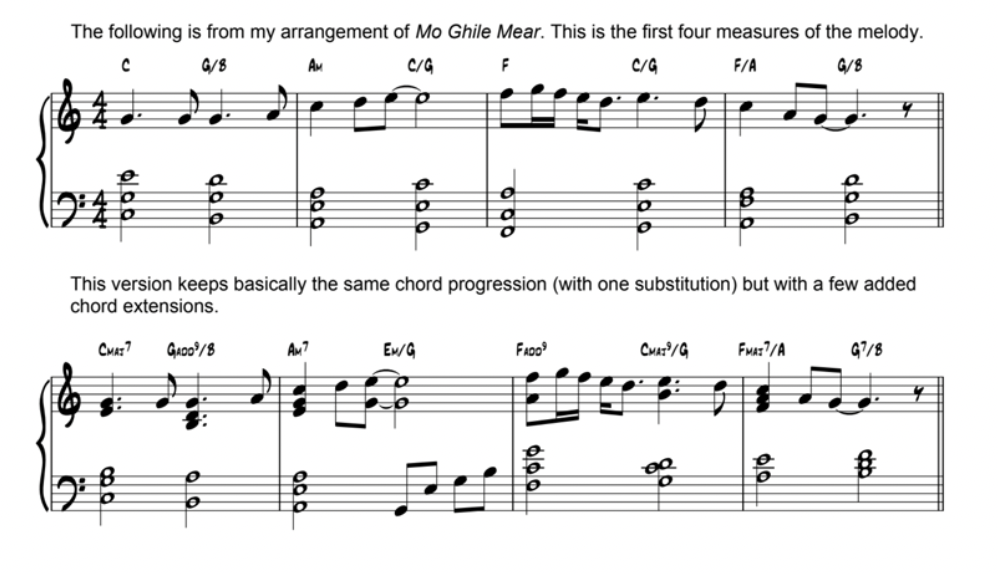
Not only does this exercise by Verlene Schermer work on extended chords, but it also will help your rhythm. Available for purchase on Harp Column Music.
Études, Traits et Exercices, Op.93, Deuxième Prélude en Ut mineur, François-Joseph Naderman
This etude has the same rhythmic pattern over a series of chord changes. Try to figure out the chord progression. For beginners, try to identify the notes that make up a triad in each right-hand arpeggio. Free on IMSLP. •
Wise words for etude exploration
Harpists have a lot of wisdom to share when it comes to getting the most out of etude practice. Their advice and suggestions can help keep you on the right track as you explore etudes.
Etudes clear our technical weeds and cultivate our artistic soil, providing the foundation of a practice ecosystem. Our daily practice tasks must be in balance (including tilling, fertilizing, planting, watering, pruning, and harvesting) for the music to finally emerge and bloom. —Jaymee Haefner
Etudes create a bridge between bare-bones drills and exercises and our repertoire pieces. They provide a musical setting, but a rather narrow one, in which to test a fundamental skill such as scales or arpeggios.
—Anne Sullivan
Think of your whole body first and always; make every action efficient, effortless, focused; take the time and patience for this and everything else will follow (tone, notes, security,
facility). —Alice Giles
Scales and arpeggios are part of the foundation of good technique and should be practiced every day.
—Elizabeth Volpé Bligh
Because scales are so tricky and difficult, I practice them every time I sit down at the harp. I still practice them as a warm up. I highly recommend students practice scales with dynamics, different speeds, and different rhythms. —Elzbieta Szmyt
I always remind myself of quality over quantity; even a few minutes of mindful, intentional practice every day on your technique will infuse your playing with greater proficiency over time!
—Grace Browning
Technical mastery is our duty and our reward. It is the skill that enables us to make the harp sing, animate our music, and sustain a long and healthy relationship with our art. —Lynne Aspnes
Assess weaknesses and drill those passages by applying various rhythm exercises to them. —June Han
Slow, deliberate practice is the fastest way to get the result you want. It allows your brain to guide your fingers as you learn new music, develop new ideas, or improve technique.
—Nicole Brady
A little often goes a long way. Understand the meaning behind everything that you practice and how you practice it. You are never too good to be better. Always stay curious.
—Amanda Whiting
Breathe in and breathe out…and then start at the last two measures. Make them shine, then work in from there, two measures at a time. —Edie Elkan
When I don’t feel like practicing, I go to the harp and play random notes and chords, listening to its beautiful sound. In no time I’m ready to practice! —Judy Loman
Harmonics have as much expressive potential as anything playable on the harp. —Ann Yeung
Placement on the string is critical for making good harmonics. The string must be divided exactly in half.
—Susan Brady
The practice of harmonics is sometimes irritating and may lead to discouragement…In general, harmonics must be played softly; they carry infinitely farther than when played loudly. —Carlos Salzedo
Learn the notes correctly. Try not to insert wrong notes or bad habits that you will need to correct later.
—June Han
If we remember that we are musicians before we’re harpists, then practicing technique will never be drudgery. Exercises and etudes can (and should!) sound beautiful when we focus on musicality.
—Kim Robertson
Every move one makes on their instrument should be guided by a clear musical intention. Only through the symbiotic practice of music and “mechanics” will the musician be able to fulfill their truest artistic potential. —Maeve Gilchrist
Optimize your time! In practicing exercises or etudes, we can do so much more than just finger work! Use also your ears to develop pulse, sound, legato, phrasing, dynamics, etc.!
—Isabelle Perrin
Knowing the form of the piece will help you divide it into sections. Practice these sections, and not always from the beginning.
—Felice Pomeranz
Implementing a few simple tasks can boost your productivity levels immensely. It’s hard to quantify the value of accumulating a handful of small advantages, like setting up a few deadlines for yourself, keeping a practice journal, eliminating phone distractions, finding a community, or reminding yourself of your purpose.
—Rachel O’Brien
Combining our ears with our emotion and intellect tells our fingers what to do, not the other way around. This complex inner ear is guiding us through creating the music and colors we desire. Tone color in harp playing is as diverse as we choose to make it.
—Rachel Brandwein
Always play a new piece very slowly, and always use a metronome. Find a slow tempo that allows you to play every note comfortably, and gradually speed it up. —Cindy Horstman