
Forum Replies Created
-
AuthorPosts
-
Gregg Bailey
MemberHi, JayDG,
All of the following are strung in pedal gut but are even larger and HEAVIER than your Korrigan:
L&H Troubadour VI (36 strings)
L&H Prelude 40 (I own one)
Salvi Ana 40 (available in both pedal and lever gut)
Camac Madamoiselle 40Are you specifically asking about pedal gut? I don’t know who all offers lever gut, but, as I mentioned, I opted for the optional lever gut on my Dusty Strings Ravenna 34 instead of the default nylon.
I don’t know whether Pratt harps are available in Europe, but all of his models feature pedal gut strings and concert spacing. However, he has been indisposed for some time now, so I don’t know if he’s even taking new orders.
-Gregg
MemberHi again, JayDG,
I was just thinking, since the Salvi Gaia and Camac Korrigan both have 38 strings and pedal gut, the Salvi Gaia would be the most like what you’re used to in the Korrigan as far as note range, string tension, etc, but in a MUCH lighter weight (about 11 kg). If you can try a Gaia, you could see if you were ok with the relatively dry sound and the way the bass wires and levers behave.
-Gregg
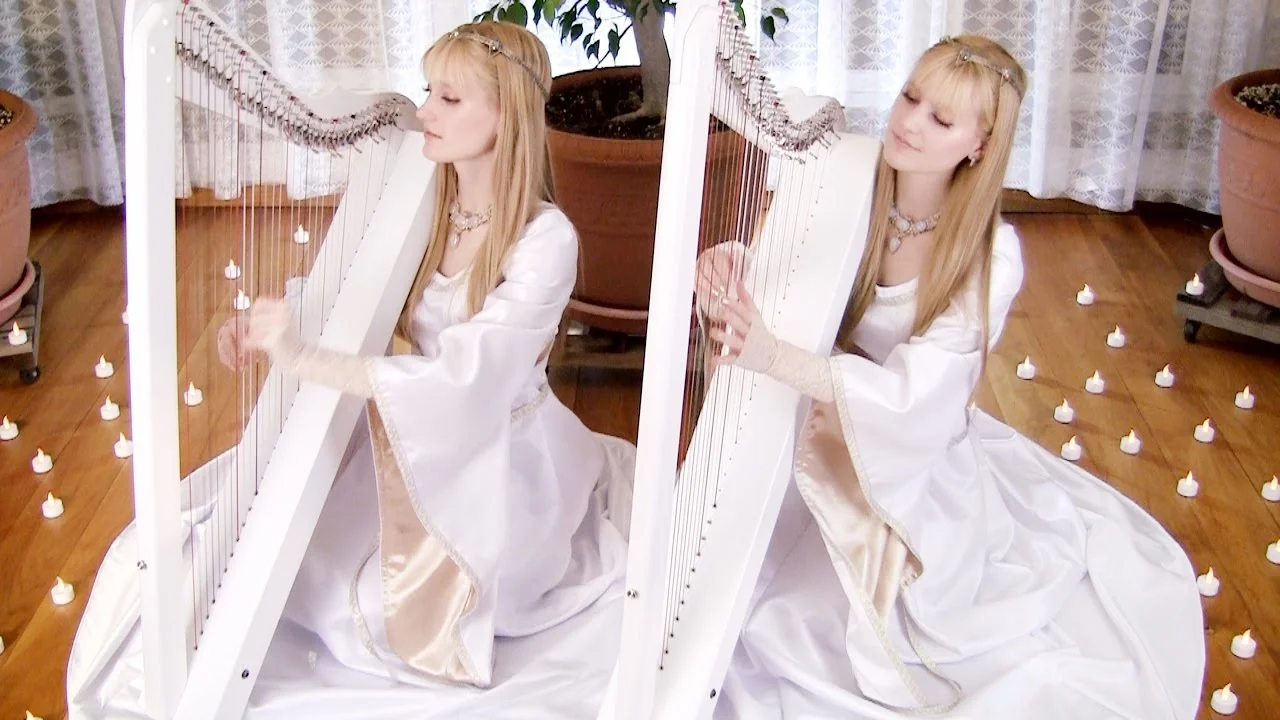
MemberAs promised, here’s the link to the photo of the “Harp Twins” playing WHITE Grand Harpsicles:
Isn’t that such a magical-looking photo?!?
-Gregg
MemberHi, Lily,
That white Salvi Daphne IS stunning; wow!! <3
I was thinking, since you’re ending up having hand swelling even from playing a medium-tension folk harp, I’m wondering if a Grand Harpsicle (in white stain!) would perhaps be a good choice for you, even as just a 2nd harp to have that would be MUCH easier on the hands. As I mentioned, I have a Salvi Gaia, Dusty Ravenna 34, and Rees Grand Harpsicle (natural maple finish) as part of my floor harp collection, and I love them all for different reasons. The tension on the Grand Harpsicle is much lower, and the spacing is much narrower than the others, so you would have to get used to that, but I find that I’ve been able to adapt to the various tensions and spacings of my different harps. The sound of the Grand Harpsicle is much smaller, of course, due to the much smaller soundbox, but it does come with a built-in pickup, and it sounds pretty good through a proper amplifier! I also love that it could be used for harp therapy in situations that would require a harp to be strapped to your body, such as strolling through a hospital ward, as it’s even designed to be wearable with a strap if needed (12 lbs), and its base is detachable.
By the way, have you seen the stunning photo of the Harp Twins playing white Grand Harpsicles? I’ll provide a link separately.
Of course, your teacher likely wouldn’t care for a Grand Harpsicle, but I could see you having one, even just to do more of your initial practicing/learning on.
At this point, due to the troubles you’re already having with hand swelling, I would NOT recommend the Gaia (pedal-tension), as the tension is much higher on it than your Ravenna. Maybe you could consider something like a Gaia in the future if your hands get strong enough for that.?
Also, MusicMakers makes a “Ballad” 34-string model which has relatively low tension and narrow spacing, and it would have a larger sound than the Grand Harpsicle. It probably has a little more tension than the Grand Harpsicle, also, but probably less tension than the Ravenna. Unfortunately, while they do offer 7 different stains, none of them are white!
Balfour and I would have no problem helping you eat that large layer cake to celebrate a white harp, haha!
By the way, I noticed in the Comments section of Kristine’s Puccini video (if you click “Watch on YouTube”) that she is taking pre-orders for that arrangement; it may even end up being in a book; I’m not sure. I have her email address, as I ordered some of her PDFs of compositions for small harps last year.
That’s good to know that your hands are a bit better.
Balfour, you are right that white is an excellent color for both cars AND harps! 😀
Photo link to follow (Harp Twins)!
-Gregg
MemberAs far as other lighter-weight pedal-tension harp models, there’s also the Lyon and Healy Ogden, which has 34 strings, pedal gut, and weighs 28 lbs/12.7 kg. There may be other models I’m not thinking of which fit those parameters.
-Gregg
MemberOf course, I meant “though,” not “thought” in my last message. In summary, if you’re wanting something comparable to the Camac Korrigan as far as having pedal gut strings but just lighter in weight, I would suggest the Salvi Gaia or the Dusty Boulevard. Sound-wise, between the two, I prefer the Boulevard, but if you’d prefer the extra strings in the top and bottom, the Gaia definitely has a larger range, and the bass wires are true pedal wires, whereas the bass wires on the Boulevard are lighter and are actually identical to the bass wires on their Ravenna 34 folk harp.
-Gregg
MemberHi, JAYDG,
I’m eager to see what harp models others will recommend, but I thought I would chime in, as five of my floor harps weigh less than the Korrigan, which, according to the Camac website, weighs 15 kg/33 lbs. They are:
-Salvi Gaia (38 strings, pedal gut, 24.5 lbs/11.1kg)
-Dusty Strings Boulevard (34 strings, pedal gut, 24 lbs/10.8kg with base, 21 lbs/9.5 kg without base)
-Dusty Strings Ravenna 34 (folk tension, same weight as Boulevard; I have mine strung in the optional lever gut from 4G up)
-Rees Brilliant Harpsicle (34 strings, nylon, folk tension, 15 lbs/6.8 kg)
-Rees Grand Harpsicle (33 strings, nylon, very light tension, narrow spacing, 12 lbs/5.4kg)
I should mention that MusicMakers has a Jolie Hybrid model which has 33 strings, nylon, high tension, concert spacing, is made of a combination of wood and carbon fiber, and only weighs 13 lbs/5.9 kg.
My Gaia is so nice in that it has 38 strings down to 6A and has pedal tension yet only weighs 24.5 lbs/11.1kg. The negatives about it that I’ve found are that the tone is quite dry, the tone of the low strings isn’t so great, and the pitch of the bass wires deflects quite a bit when plucked strongly, as they start much sharper on the attack before settling into their true pitch. The levers are also a bit noisy with a “clack” when disengaging and, to a certain extent, when engaging.
I absolutely love my Dusty Boulevard and Ravenna 34; two similar-looking harps with very different characters, as one has pedal gut and the other is in folk tension, but they both have a beautiful ring in the sound.
My Rees Brilliant Harpsicle 34 is astonishingly lightweight (15 lbs/6.8 kg) for being made of solid wood and having 34 strings of medium tension and spacing. It’s warmer-sounding than my Ravenna 34, thought the bass end isn’t as strong.
My Grand Harpsicle 33 is ultra-lightweight at only 12 lbs/5.4kg, but you would have to adjust to the low tension, narrow spacing, and small sound. However, it and the Brilliant come with a built-in pickup by default, and they sound fantastic through a proper amplifier (particularly the Brilliant). The Grand Harpsicle has the added advantage of being designed to be playable wearing a strap and strolling around, and its base is detachable.
I’m sure Balfour will chime in about his wonderful Dusty Strings FH36S which can weigh as little as 25 lbs/11.3 kg depending on the wood chosen.
I hope this helps!
-Gregg
MemberHmm, the link I provided above for the white Salvi harp isn’t working on my computer, because the HC forum is substituting a multiplication symbol instead of the “x” character between “683” and “1024” for some reason. If you click the link and then replace the “times” symbol with an “x”, it should work.
-Gregg
MemberAnd have you seen this custom white-and-gold Salvi Minerva, Lily?
https://www.salviharps.com/wp-content/uploads/2016/05/Minerva-bianca-1-683×1024.jpg
MemberAnd the link to the photo of a beautiful White Brilliant Harpsicle (this makes me want to eat a Zero white chocolate bar, haha!):
https://harpsicleharps.com/seconds/harpsicle-harp-brilliant-white-second
-Gregg
MemberLily,
I will attempt to provide the YouTube link to Kristine’s Puccini harp video here:
MemberHi, Lily,
How are your hands doing now? I feel so bad for your having had to deal with that when you’ve just been so passionate about practicing!
At risk of causing you to want to practice even more, I thought of you the other day when I saw Kristine Warmhold’s video of her playing her arrangement of Puccini’s “O Mio Babbino Caro” on a (Camac ebony finish) lever harp! She posted it 3 weeks ago. I will attempt to post a link to the video separately, but if the forum doesn’t allow me to do that, just look up her name on YouTube along with that title. I’ll also attempt to link you to a photo I found of a white Brilliant Harpsicle! It’s too bad that Rees Harps determined that staining the Brilliant models took too much time to be cost-effective. I don’t understand why they can’t simply offer that for an extra charge.
I hope your hands are recovering!
-Gregg
MemberAlso, was your saxophone a “left-handed” saxophone? If so, I’ve never seen such a saxophone! Again, both hands do the same sorts of movements on a “woodwind” (I play sax, flute, and clarinet myself), so the idea of reversing the hands on a woodwind doesn’t make sense to me, either.
I just realized, is your saxophone experience the reason that you want to play the harp with the left hand above the right, since that’s the usual hand arrangement on sax?
-Gregg
MemberHi, Shirley,
May I ask what model of harp you play and on which shoulder you rest the harp? Unless it’s a double-strung harp or Paraguayan harp in which it wouldn’t matter to which side of the harp you sit due to symmetrical construction, or some sort of special-made harp with the strings on the opposite side of the neck, I assume it’s a conventionally-made harp with a single course of strings. If that’s the case, have you considered simply learning the harp in the conventional manner, sitting with the harp on your right shoulder and playing the treble with the right hand and the bass with the left hand?
Personally, I’ve never understood the concept of right- or left-handed musical instruments, because both hands are always very active. And, in the case of keyboard instruments and harps, both hands essentially do the very same thing. The concept of a left-handed guitar really puzzles me, because, if anything, the left hand is even MORE active in a so-called “right-handed” guitar, as the left hand goes up and down the fretboard while the right hand stays in one place just doing the picking.
On the harp, each hand is equal in importance and needs to have equal strength. This idea of one hand being more important than the other because it has the melody notes seems maybe a bit silly to me. If both hands are properly developed in technique, each hand should be able to play the melody in whatever range of the harp.
As far as fingering, the harp is unique in that the fingering is exactly the same in each hand for a given one-hand pattern.
I’m curious–whose idea was it that you should learn “backwards” to the conventional manner just because of being left-handed?
I’m not sure if my reply has been helpful, other than that I would strongly encourage you to try learning the conventional manner of harp playing for a little while before completely giving up on the idea, as I think it would take you much farther to be able to do that, since the vast majority of harps are designed for the harp to rest on the right shoulder and for the right hand to be above the left hand. I can’t imagine trying to reverse that while the harp is still on the right shoulder, and I also can’t imagine trying to play a conventional harp resting on the left shoulder since you need to be on the same side of the harp as the strings.
MemberHi, Carl,
Where can such a humidifier be purchased? I’ve never seen a type which humidifies invisibly; that sounds fascinating! What are some specific brands that you know of that make such a humidifier, and what do you look for on the packaging to know whether a particular humidifier is of this type?
Thank you,
Gregg
-
AuthorPosts