
Forum Replies Created
-
AuthorPosts
-
hearpe
ParticipantYou’ve got a nice touch on the strings already and a great sounding harp! Enjoy!
ParticipantComic books are such S&M trash these days. Not to offend, just my opinion.
ParticipantThe only thing about the harp you pictured Katia is that there are no sharpening levers- so you’re stuck playing in C unless you retune the strings with the wrench every time- and that can wear the pegs out.
I’m just getting ready to list a virtually new Roosebeck Heather 29 harp with a birch soundboard and 24 levers- I bought before I found a larger harp- I could sell that for $400 shipped in the original container if you’re interested. They are $100 or more new on Amazon and ebay and this one is two months old and played very little- not a scratch, if you’re interested.
ParticipantMy gut feeling- no pun intended- from my limited harp experience, but my longer classical nylon string guitar experiences-
is that the condition you describe IS probably more likely to be string related. Nylon strings will take on a length over time and go through the same thing as when they are new in terms of stretch-but generally not quite to the same degree.
Not actually seeing the harp, I couldn’t say for certain- but try to do the best visual evaluation you can- there may be some acceptable natural bow under tension, but this shouldn’t grow that appreciably tuning it up slightly.
Also pay close attention to how much resistance seems to be on the pegs= if they feel extra loose tuning it- by comparison with the others- it may have some problems related to worn peg holes
If it’s worth it, you probably want to go with some new strings as soon as you can- maybe even beef up the gauge a little bit if they are very thin.
ParticipantNo I ordered a replacememt string from Dusty Strings because I COULDN’T get a replacement from Pakistan and Mikel Celtic. They only forwarded me some web sites here in America and those were vague.
Would’ve taken forever anyway, an I had the one from Dusty Strings within the week. The Strings seemed to match on position and specs, only the length was in any doubt, and the string fit perfectly.
Fortunately, only one has broken so far, and it was the thin winding portion of a heavy nylon wound string- the #26 “D” I think it was.There is some variance in the bass strings otherwise, between my harp and a Ravenna 34, and eventually I may gradually convert to the Ravenna standards, with both a couple more nylon wound nylon and steel wound strings, I’ll be studying the recordings on youtube and comparing them with the sound of my own Celtic.
ParticipantI love this instrument !
Harp is still behind classical guitar and piano and violin in terms of time I can give it, but how very pleasing to sit down and plunk upon, and I look forward to progressing in form and skill
Here’s a short video- just to demonstrate the harp- NOT my playing or annoying heavy breathing!
Anyway despite having a string break spontaneously and a week down to get a replacement from Dusty Strings-customer service from Pakistan is sadly lacking so I might recommend a purchase on ebay if available and then backed up by their buyer protection, like how I got mine- and almost a month delivery- I’m very happy with it and not financing something even more expensive, cause I really don’t have the means. A good harp for the price and I’ve been getting an education on harp strings which seems to be the greatest difference between many similar harps- the better ones are a little beefier on the bass, but just getting a feel for the sounds and have the option of getting more wound strings later. This has more wound strings than the Roosebeck Mehgan 36 and even less expensive and a better design overall I think.
September 26, 2015 at 9:42 pm in reply to: Heartland's Infinity 36 CF harp – What do you think? #190468ParticipantLightweight is good- does anyone have some video link of this harp?
And does anyone have any links to some video comparing gut to nylon?- I’m no where near any harp outlets that I could personally peruse such comparisons.
Got flooded out of Bloomington IN area awhile back or I could see the harps at Vanderbilt.
My new Mikel Celtic 34 broke a string last week, so I’ve been researching replacements a bit- and finally got one from Dusty Strings- the same number and note as a Ravenna 34, and it fit perfectly-
Other than that, the Dustys appear to have slightly beefier(one or two more nylon wound and one or two more steel wound strings on the bass end), so I may want to replace some strings there eventually.
By contrast the Roosebeck Meghan 36 has many less wound strings on the bass, so I’m not unhappy with the setup on the Celtic 34, especially considering it was less than half the cost of a Ravenna 34, and a whole nylon replacement set would put it up to about half.
Totally unfamiliar with gut though. Expensive, no? Are they worth it?
And would one typically replace only part or all of them?
ParticipantI’m becoming a big fan of arpeggios and scales- My piano playing is improving greatly since I got a couple of basic books with some simple exercises- I’m widening my experience up and down the keyboard, and I’m finding the very same exercises work well on harp. They especially have shown me how different the harp sounds in other keys- simply played on a piano but set up with the levers on my harp. Repetition of the exercises seems to give one a feel for which notes go with which, and how to get to them more quickly as you move up and down the harp scale. Highly recommend.
ParticipantThose are nice easels Biagio.
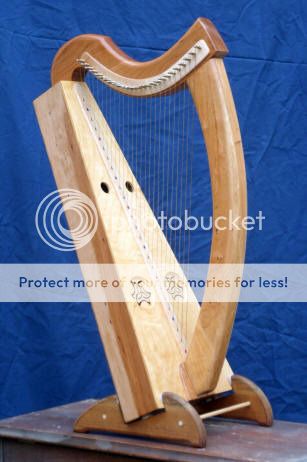
I was also considering this design before I made my harp stands from a barstool, and may someday use it:
http://i720.photobucket.com/albums/ww206/nancyewilson/Bard_Cherry_3moons_zpsok44saut.jpgI was thinking the bottom pieces could be 8 or 10 inches verticle instead of the low height on thisharp, and the design is simple, with the dowels holding it together horizontally.
http://i720.photobucket.com/albums/ww206/nancyewilson/DSCF2024_zpsdu5pknwd.jpg
ParticipantYes I still have the Eve22 and often play that in an easy chair, I suppose it will fit on the taller stand if I want.
I may actually sell the Roosebeck 29 if anyone’s interested. I had ordered that when the Mikel Celtics were listed. Brand new but too late to return.
Participanthttp://i720.photobucket.com/albums/ww206/nancyewilson/DSCF2022_zpsi4riqzcd.jpg
http://i720.photobucket.com/albums/ww206/nancyewilson/DSCF2023_zps96srvhu5.jpg
http://i720.photobucket.com/albums/ww206/nancyewilson/DSCF2024_zpsdu5pknwd.jpgWith both stands, I am not going to secure the harp to the base, because I still lean the harp back when I sit in a chair. They work pretty well!
Mikel Celtic says they have 10″ optional legs (“not always available”) I think I’d have to order from Pakistan, and I think you have to remove the feet already there- My stand is 11″ from floor to the top
the top part of the barstool left for the Roosebeck 29 measures just over 18″ high.ParticipantParticipantNot much of harper here, but I can crudely pluck out stuff that sounds like a tune.
But I can usually pick up a guitar or sit at the piano, and be playing along by the end of most songs by knowing a few basics about song structure-
so “playing by ear” is most easily done with SOME knowledge, consisting of two main components:
1. The knowledge of “Keys” and their scales-
2. the knowledge of the Three Chord TheoryThe first -knowledge of the keys- is most important and best learned on piano I think, by playing the Major Scale (Do-re-mi-so-fa-la=ti=do) off of every key- you get to know the key scales- ie “C” has NO sharps or flats,
G has one sharp “F”, “D” has two sharps- F and C, “A” has three sharps C,F and G, and so on-On a piano or keyboard, the tones and their relationships are all there in front of you to see. But you have to know how the Major Scale sounds so that you can play it- find it if you will- from any note you start on.
You can get a cheap keyboard these days for $50 or less, and it would probably be of value.as the keys get more sharps and flats they are generally used less often. C, G and D are used frequently on harps and some only have those levers t accommodate those three. Violins have four strings GDAE- all the note scales have a progressing ordered number of sharps as you move to the higher strings, and much of their music resolves to those open string notes, or uses those key signatures GDAE. D has one more sharp than G, A has one more sharp still than D and E has even one more than A.
A viola is CDGA and so keeps the same progressive key signature progression- it just starts with C- and NO sharps- at the bottom lowest note, yet the strings have the same relationship as the violin, and so you can “play by ear” or using the same hand position the same music, it will just be a fifth lower.
The second important component of “playing by ear” – The three chord theory- is that most modern music is often built around the I, IV, V progressions and mixtures- The use of the Roman numerals is a relative identification, to describe the relationship based upon the note or major chord one starts with. When C is the I, the IV is F and the V is G. When D is I the IV is G and the V is A. And so on.
There are many places to find better explanations of the I iV , V theory, so you have to have a grasp of that, and then also realize that not all music “moves” that way, but most music uses AT LEAST two chords of the I IV V relationship- Some music only ever even use ONE chord throughout.
So anyway, once you have a grasp of those two things, you can generally find the key by listening to what note a piece RESOLVES to at the end of the main phrases. Pluck the guitar or harp string, play the piano key, and when you get the one that matches the resolving tone-
that is generally the key signature and I chord tone, for most music. The piece changes to another chord center as it goes along- quite often the chords then built on the IV or V of the main resolving tone. If it’s in a minor key, or strays from I IV OR V it gets more complicated.
but using those two pieces of musical knowledge can get you started playing along with most recordings.
ParticipantUgh, the trains outside just woke me again. 3:30 am.
Two days with the harp and just settling in to tune- I guess I can get a snap or two up, but a video may take few days.I can’t play much just a few open chord progression. I was playing earlier and thinking the rhythmic result would make a good rhythm track for other instruments over it.
I think this instrument is going to grow on me, and if I can’t sleep at nights, I won’t feel that I’m making a lot of noise as with piano or guitar.
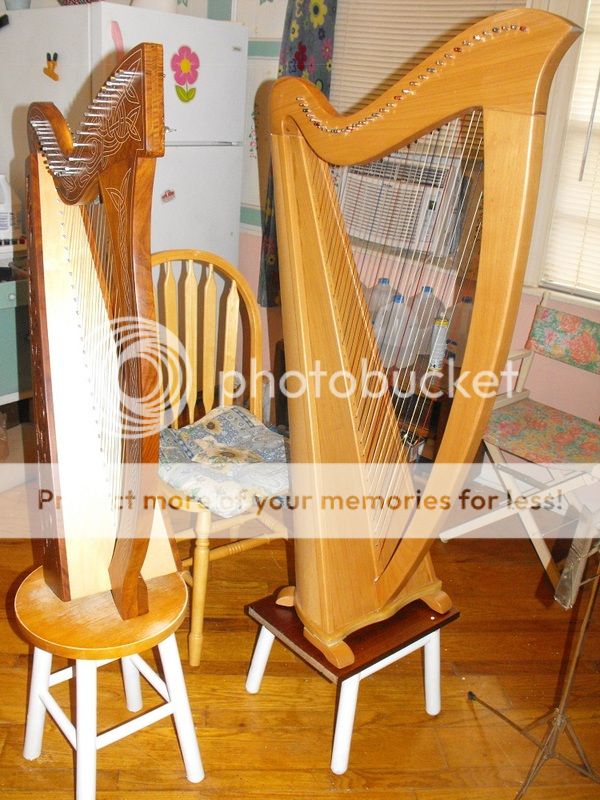
ParticipantOh well, I’m now the owner of Mikel Celtic Saffron 34 harp. And very pleased, it’s a whole new experience. The harp is resonant, has good volume and well made, the tuners function smoothly. I have really little else to compare it to, but after having shopped around it seems a lot of harp for the money, and with a nylon case.
I wish I had known of this harp a week or two before I became aware of it, and I probably would not have the Roosebeck 29 Minstrel- which is a nice harp, but in a different class, and having all monofilament strings. The 29 I think could use a rounded back and lighter soundbox- mostly the sides- and I talked about trying some wound basses on it in another thread. I’ll probably try to sell it now.
I’m now of the opinion that you have to have some wound basses to get the real experience. Someone was critical above of the Roosebecks, but I think there are decent ones. The Ashley 31 has a rounded back and wound basses and seems fairly nice in quality. The 36 Meghan has a more rounded back and a lot of strings, but dollar for dollar I think this Mikel Celtic is a better harp at less money then.
But my Mikel Celtic has 34 and will probably be the last harp I’ll buy.
I think it’s a good solid first serious harp for anyone not wanting to spend twice as much. I’ll bet the price will be going up eventually.Just a hack for now, but I’ll be practicing!
-
AuthorPosts