
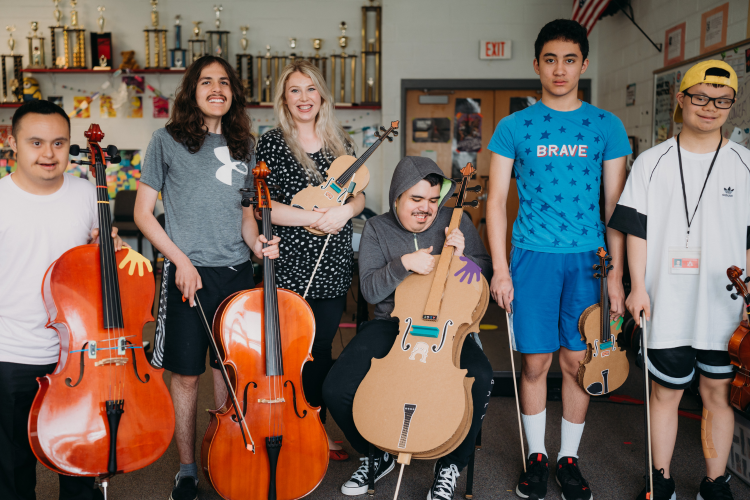
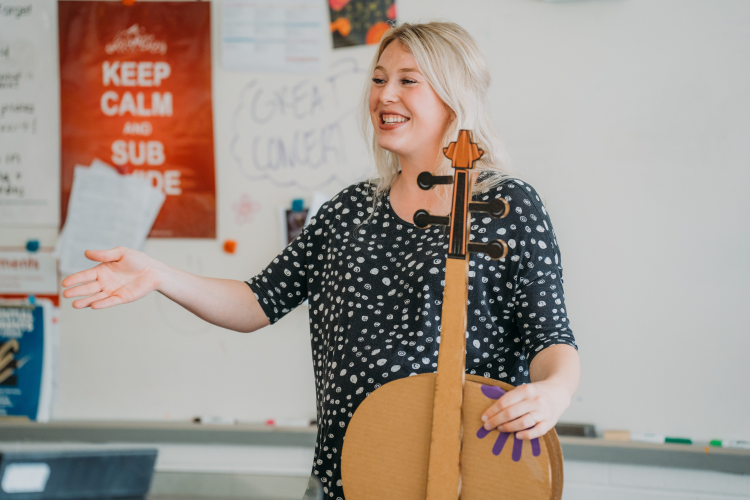
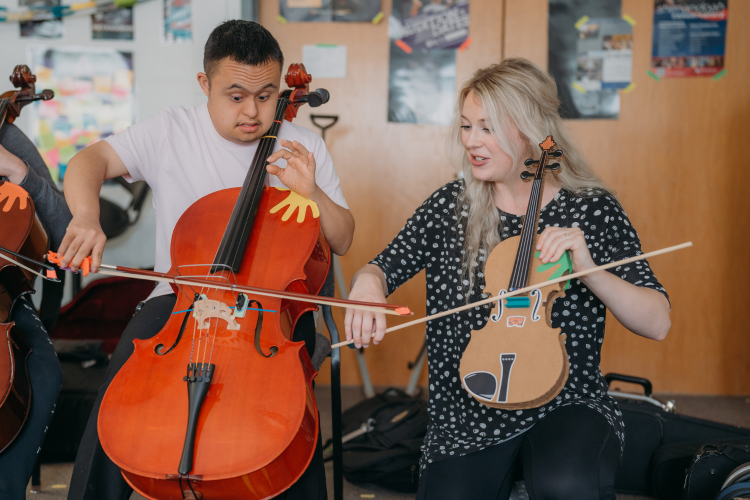
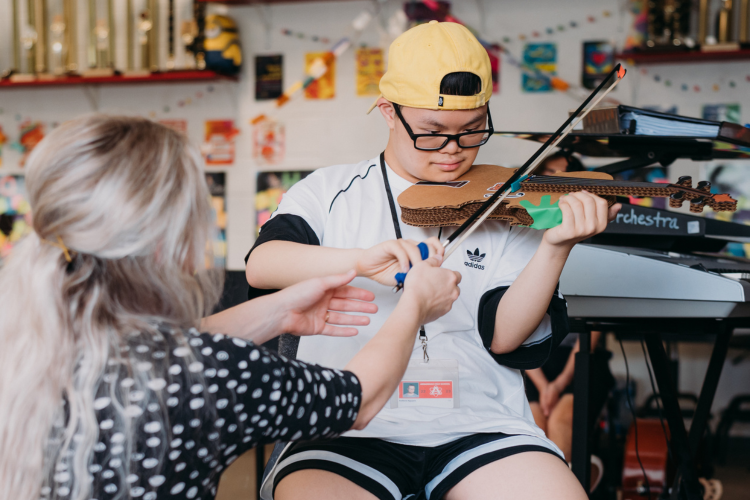
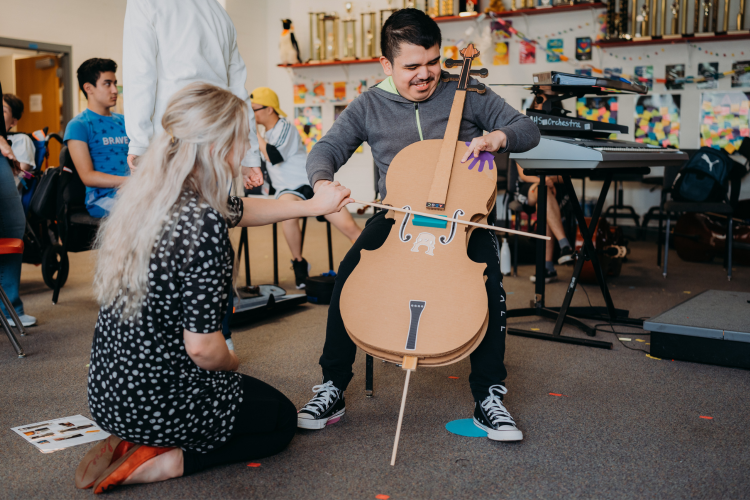
In 2018, high school orchestra director Annie Ray started the Crescendo Orchestra for special education students.
photos by Benson Park Photography
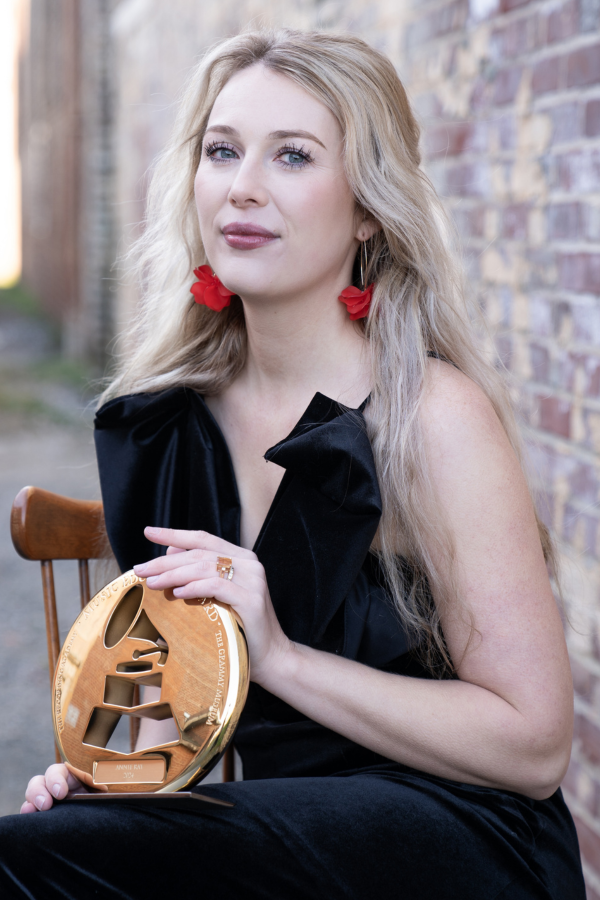
“This award isn’t just mine—it’s very much a group project, and my name just happens to be on it,” says 2024 Grammy Music Educator of the Year Annie Ray.
photo by Paige Fremder, Hey Next Paige Photography
Anytime a harpist makes headlines out in the “real world,” our little corner of the music world gets excited. We point out the harpist to all our friends and say, “Look what she did! I know her! She’s one of us!” Obviously, we don’t know every harpist we see in the news, but we feel like we do. Our shared experience connects us with other harpists we have never met and makes us feel like we’ve known each other for years.
So when Annie Ray won the Grammy Music Educator of the Year award earlier this year, the harp world was beaming like a proud parent as one of our own received the nation’s most high-profile award in music education.
When we caught up with Ray at the end of a busy day of teaching at Annandale High School, a few weeks had passed since she walked the red carpet at the Grammy Awards in Los Angeles. But it wasn’t the hug from Taylor Swift or the chat with Oprah Winfrey she wanted to talk about—she couldn’t wait to tell us all about her students. Ray lights up when she talks about the orchestra students at her Northern Virginia public high school. “My kids are the coolest kids,” she says with her big trademark smile. Ray’s enthusiasm and deep-seated belief in music education for all students make it clear why she was recognized by the Recording Academy with its highest award for music teachers.
Her students were not the only people Ray credits. Time and again she points to the music teachers she had growing up, the mentors who showed her what was possible, and her teaching colleagues who she continues to lean on and learn from every day. Ray makes it clear that you can’t be a good teacher without also being a good student.
Harp Column: Congratulations on your Grammy award—what a thrill! Take us back to the moment when you found out that you won the Grammy Music Educator of the Year award.
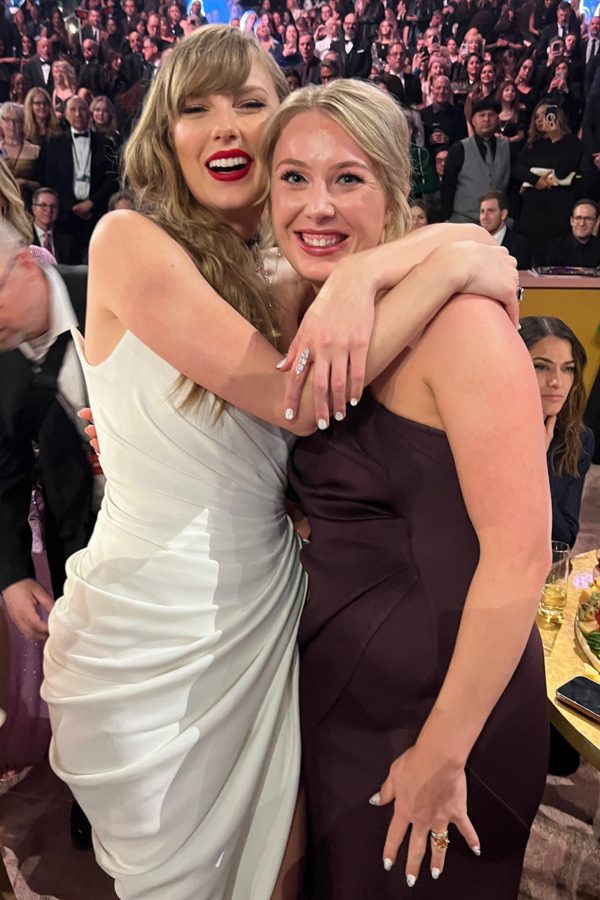
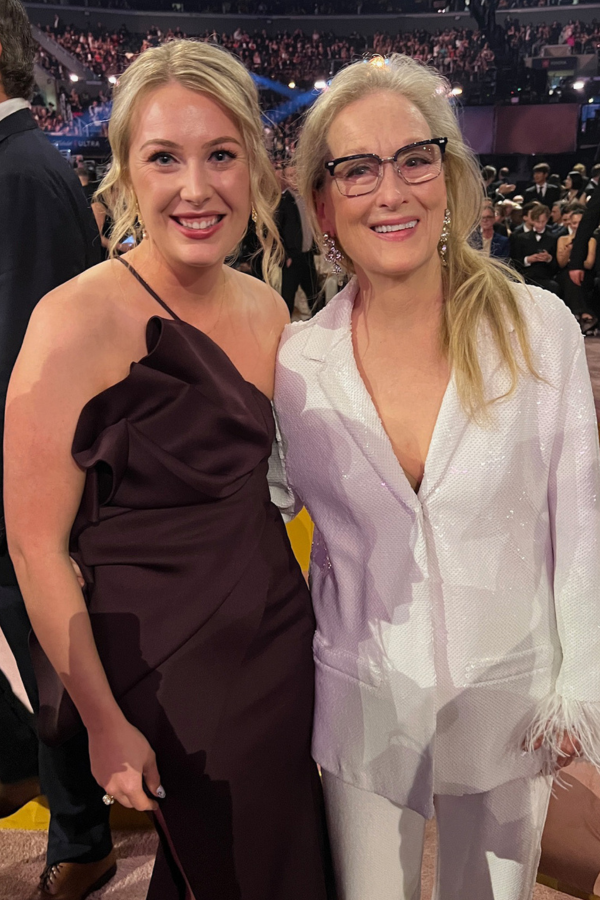
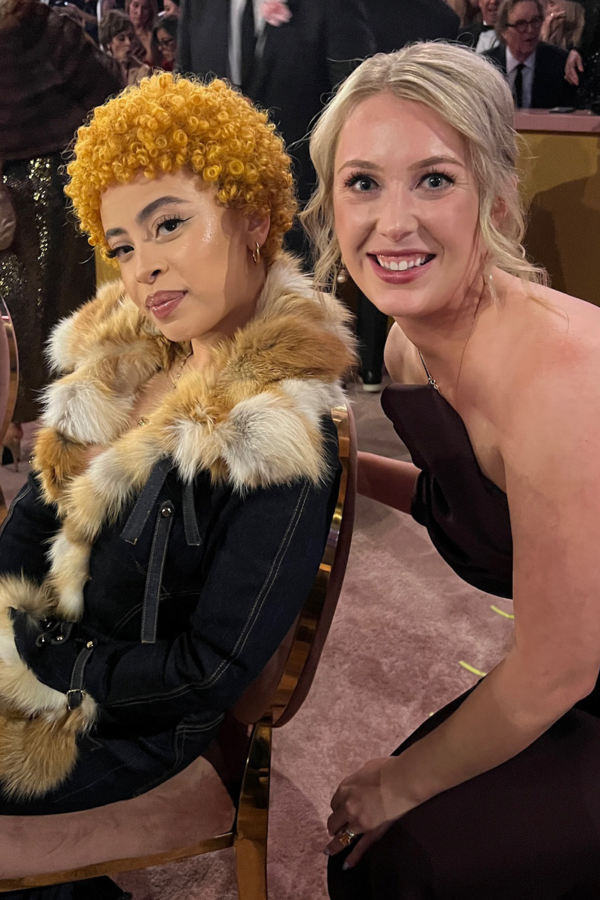
Annie Ray is all smiles at the 2024 Grammy Awards with actress Meryl Streep (center), Taylor Swift (left),and Ice Spice (right). Read more about her big night.
photos courtesy Annie Ray
Annie Ray: It was shocking, and also a weird juxtaposition. I knew I had been nominated and that I was a finalist. I have two little girls—a two-and-a-half-year-old and a five-month old at the time. When I got the call [that I was the winner], both girls were melting down. I’m on the phone, both girls are screaming, and I hear “You’re the Grammy award winner” while my girls are melting down in the background. It was weird. [Laughs] And then I had to keep it quiet for about a month. I couldn’t tell anyone. All of my students found out together when CBS aired their segment [on the Grammy Music Educator of the Year]. So the school put together a watch party, but the students were like, “This is great, but it’s going to be really awkward if you don’t win.” [Laughs] But it was a great moment of celebrating together. And then my speech wasn’t televised, so I was able to give them my speech in person, which I had written for them. It was a nice full-circle moment.
HC: That sounds like such a special moment. I want to know more about your work at Annandale High School. You’re obviously not the run-of-the-mill orchestra director, you’ve done some different, innovative things with the Crescendo Orchestra and your parent orchestra program. Tell us about these two programs and how that came about.
AR: I’ve been contemplating this award and everything it means. This award isn’t just mine—it’s very much a group project, and my name just happens to be on it. All of these things have come together—many people, many different ideas—in this community of Annandale, [Virg.], and these people have taught me more than I’m ever going to teach them about what music is really about. The parent orchestra idea comes from my mentor, Brian Coatney. He’s at Wylie High School [in Wylie, Texas], formerly at Plano [Texas]. He has a small group of parents in an orchestra, so I started it up here. I started it because there was a parent on Facebook who posted something like “Oh, no, Jimmy brought home the violin and I want to put in earbuds while he practices.” It was disheartening to hear because, as a child, if your parents are complaining about you practicing, it’s not a good feeling. It doesn’t make you want to keep practicing. So the parent orchestra was a way to connect parents to the process of learning something new. You have to learn how to make bad sounds before you learn to make good sounds. It blew up from 15 parents in 2018, to now over 200 caregivers. Plus, we have like a close to a 100-person wait list. It’s unbelievable. Again, it’s all thanks to a group effort. I have this incredible team of teachers who volunteer their time with me every year to teach these parents. The [experience level of the parents] ranges from people who have never played a musical instrument before, all the way up to people who played in high school or have some similar experience. Playing in the orchestra helps parents and caregivers understand the sacrifice of learning something new and the joy between the notes. They get to experience why orchestra isn’t just learning about how to play an instrument. It’s so much more than that. But then it got bigger. We have people who are student teaching who come and are mentored by us experienced educators. It’s also become this experiential professional development. When you’re a music teacher, you’re often the only one in your school, right? But now we’re watching each other teach. So it’s become like this experiential professional development where we can learn from seeing each other teach, so it benefits everybody. We’re all getting something out of this.
Then Crescendo Orchestra began in 2018 with two twin brothers who were put into my general education orchestra. They have higher support needs, and I felt like I was absolutely failing these students. They weren’t engaging with me. They didn’t seem to be happy to be there. But then I held back one day after class to work with one of them one-on-one. I realized that he knows literally everything that I’ve been teaching this whole time. He was just processing it differently.
I had heard about the Giving Bach program, which is kind of like Best Buddies/Special Olympic style, where a student with higher support needs is paired up with a gen ed student after school, and they get to experience an instrument. So we started talking about that, and then I moved to a different high school, and then the pandemic started.
During the pandemic, I was here in the building teaching my students online. I was super, super pregnant, so I would walk through the hallways. The special education department had come back into the classroom, and so I popped my head in. I was so happy to see people! I just invited them down to my orchestra classroom because they were struggling with online learning, like everybody was struggling, but I said, “Hey, let’s just check out these instruments. Let’s just kind of do this Giving Bach thing, but with me acting as the gen ed student partner. One of the students, his name was Kevin, was not happy to be there. He was so mad that he was out of his routine. But then I started playing the cello for him, and he asked to hold it. So I said, okay, and he grabbed the bow out of my hands and started bowing back and forth, and his eyes started tearing up, and he just loved it. He didn’t want to leave, and it took multiple people to get him to leave. So I invited them back again, and again, and again. Then I went and watched their classes. I asked them to send me their slides, and I called the general music teacher down the street and said, “Tell me about your enhanced autism class.” And I called my mom who’s a general music teacher. And I said, “Can you help me create this?” So I started working through all of this and developing the program with the instructional assistants, the occupational therapists, and the special education teachers here. But people don’t realize that there are a lot of these programs out there—it’s not just me. And the really cool thing is that some of them have developed at similar times as ours, and we all have our own take on it. It just shows where the music education community is going in supporting every single student where they’re at. It’s beautiful. When it came to making my schedule for the next year, I went to my principal and said, “Hey, instead of an after school thing, let’s make this orchestra its own dedicated class. So they meet with me just like all my other gen ed students, for 80 minutes on the block period every other day. And it’s been the greatest joy of my life.
HC: Why did you think it was important to do it during the school day rather than an after-school activity?
AR: Because they are people, they are humans, they have the right to have an orchestra class during their school day, not as an afterthought. The Giving Bach program and others like it are incredible resources and starting points. But I wanted them to actually learn how to play the actual instrument and be an actual performing ensemble member, and be really treated as equal. People ask me why I don’t integrate them into my multi-level orchestras. And the reason for that goes back to those twin boys that I had in my orchestra classes that inspired all of this. They knew everything that was going on, but I was not meeting their full need, their full potential, their full love of music. But here in the Crescendo Orchestra, I can work with each student one-on-one and give them the attention that they need and deserve in order to learn. It’s just like how I wouldn’t mix my beginning orchestra class, many who have never touched an instrument before, and my advanced orchestra, who is playing major repertoire. I wouldn’t be able to meet the very different needs of the students in those two classes. It’s the same thing here. These kids still get to play on every concert, they get invited to every social event, and they’re treated as a full member of the ensemble.
HC: I’ve read where you have said that your students have taught you more than you’ll ever teach them. What have you learned from your students?
AR: Annandale is an incredible community. And the reason I bring that up is it’s one of the most diverse schools in the country. There are 66 countries represented here, 59 different languages. We had students who were refugees, students who just immigrated, students whose parents immigrated just before they were born, students whose parents have been here their whole lives. We have a wide range of not just countries, but backgrounds and perspectives. I’m in a world right now where a lot of people just don’t get along out there, but in my music classroom in Annandale, they are all getting along.
I was trained in a very intense, traditional, classical musical tradition. When I came here, I thought that’s what I wanted for my classroom. But I’ve been freed of that idea. The act of making music is universal, and I found that what I love about music is connecting with people and having that moment to talk and share. That’s why I love Crescendo Orchestra so much—all expectations have been stripped away, and it changes every year based on who’s in front of me. We start at the humblest level and make a single note. And then to have these students and families invite me into their homes and teach me about their cultures and be vulnerable with me has been the greatest life teacher. These students have taught me what it means to meet everyone where they’re at, and that has reshaped my entire teaching philosophy and reframed what success actually means. It’s been a very humbling experience. Some people will say that to meet kids where they are and connect with them, you need to let them pick the repertoire. Yes, that’s a great tool, but an even better one is to say to them, “Hey, this is why the music I’m teaching you is important. How can I bring it to you, meet you there, and bring you along with me? Yes, we’re going to do R&B and hip hop, absolutely. But I’m going to make that connection there and teach you about the full rest of the world instead of just the narrow slice of music you are interested in.”
HC: How has your experience with the Crescendo Orchestra changed how you teach your gen ed and your more advanced ensembles?
AR: Playing tests are a great example. I have this whole rubric I use and students come play for me one by one. Well, Jimmy has been working on straightening his wrist when he plays for two years. He finally comes in and plays with this beautiful straight wrist, but now he is super out of tune because he’s not used to playing with correct position. I’m staring at my rubric thinking, how can I take points off for his intonation when he finally succeeded in fixing the wrist position we had been working so hard on? So I just scrapped the rubric and redid it to identify each student’s individual journey. I’m marking up their music left, right, and center, but their grade reflects their actual personal progress. So now it’s a balance of pushing each student for musical excellence while also celebrating the journey along the way and the steps it took to get there.
HC: You’ve shared some powerful success stories, and clearly you are really energized by your students and your work. But it’s probably not all rainbows and unicorns. What can be difficult about your job? What do you struggle with as a public school music teacher?
AR: There are a few things, but the hardest thing is balance. The job is all consuming. I don’t feel more alive than when I’m on the podium with those kids making music and connecting with them. I feed off of it. But I’m also a mother. I have two young girls that have been my greatest teachers in life. The struggle of many women who are music educators is, when they have children, they leave the classroom because our job is so all consuming. It’s emotionally demanding, it’s physically demanding, it’s mentally draining, and then you come home and being a mother is similarly all consuming. And then on top of that, I still gig and perform. I’ve had to develop systems and structures to balance everything. Some women step back from the classroom, and that’s the right decision for them. But for me, I want to say yes, I can be a music educator. And yes, I can be a mother. And yes, I can be a performer. And you know, being a teacher makes me a better mom. That has been like a huge struggle and challenge to balance for me the last few years. I know I’ll keep learning and struggling through it. But I’m very lucky that I am extremely supported here.
Another challenge is staying up to date on pedagogy and best practices when we’re given such little time to work on that. I’m primarily a harpist, so I always try to watch as many colleagues as possible, whether it’s a math teacher or an orchestra director, to stay on top of teaching practices.
Finally, I think there is a fundamental lack of understanding about what music education actually is. We are not here to create the next Yo-Yo Ma. If we happen to do that along the way, cool, but we’re trying to create good people. There’s so much to learn between the notes on the page, and that is what we, as music educators, are teaching our students each day.
HC: Well, you kind of led right into my next question. If you could wave a magic wand right now and change one thing about music education in this country, what would it be?
AR: I would make the performing arts a core class in school. Despite me having an army of students signed up for my orchestra classes next year, each year I have to sit with so many kids and figure out how we are going to fit orchestra into their schedules. I’m calling parents and telling them their kid can be incredibly successful in school and in music. I can go out and advocate and speak to non-music people all the time about the importance of music education by telling our story, but it will never be considered equal or legitimate unless music is made a core subject. There is an emphasis in schools on social-emotional learning right now, and there is no more authentic, meaningful, purposeful, real way that students can learn these skills that they will carry with them throughout their lives than through music.
HC: Tell us about how you got started in music and the harp.
AR: I am lucky—I come from a music family. My mom started me on piano when I was three. She’s a pianist herself. Then we were at a Mexican restaurant, and I heard a harpist playing, and I was just enamored with it. So my parents rented my first harp. It wouldn’t have been financially possible without my grandmother—she is the musical matriarch of my family. She is the only reason that we were able to afford it. She got me going and made it happen. I studied with Naoko Nakamura—she is the harpist with the Dallas Wind Symphony Orchestra and adjunct faculty at Southern Methodist University. She is a phenomenal harpist, and she has no idea how much she shaped who I am and how much I admire her. She’s a strong, incredible woman. I was with her all the way through my senior year at the Greater Dallas Youth Orchestra. I got to play in the schools as well, thanks to my mentor Dennis Langevin who fought for me to be in there. I think I was one of the first harpists in the north Texas area to go through the whole school system. Since then they have the big Frisco [ISD] harp program, and the harp is very big in north Texas. Then I got to study at the University of North Texas with Dr. Jaymee Haefner, who was also an incredible, inspiring, strong woman who really shaped a lot of who I am.
HC: Were you a music ed major at North Texas?
AR: I double majored in performance and music education. I ended up accidentally specializing in wind symphony performance. I got to do the Glière harp concerto with Eugene Corporon and the North Texas Wind Symphony, which was a huge high for me. I still play a lot now and gig around here.
HC: Wow, I didn’t even know that there was an arrangement of the Glière for wind symphony.
AR: Yes, it’s very obscure. I just love the Glière, and it was only the first movement that we did, but it works. It was a very cool opportunity.
HC: I have to imagine that it is unusual for a high school orchestra director to come from a harp background, rather than a string background. I’m curious how you think your harp background has served you in teaching string students.
AR: I love this question because I think more harpists can and should go into music education. I’ve had great mentors—Dennis Langevin and Brian Coatney, and also Megan Gomen—she is a harpist and was one of my orchestra directors in ninth and tenth grade. Then the University of North Texas was so supportive. You take those method courses, like brass methods, string methods, and I asked them if I could take private lessons on these string instruments instead of a methods class. So I just took tons of private lessons on all of these instruments so I was actually learning to play all of them. It has been such a benefit. When I’m teaching now, I can articulate very clearly the instructional nuances because everything is so fresh in my mind. It wasn’t that long ago that I was learning how to play these instruments. I deeply know their repertoire, because I have to learn it deeply in order to teach it right.
In string pedagogy there is a lot of playing in front of students, which I love. But oftentimes, it ends up being a student just copying what they see their teacher doing versus thinking through the mechanics of something. I’m a pianist also, and I play all of the parts along with them on my piano all the time so they see how things fit in and talk a lot about theory. Why would a shift happen there? How are we going to access that? So my students really understand the deep DNA of the music and how it applies to their fingerboard as a result.
There’s also so much of our harp pedagogy that crosses over, like the way we hold our arms, the way that we have to sit, the way that we hold our instrument, the way that we have to breathe. There are so many more similarities to other instruments than people realize. If we made harp part of beginning pedagogy and treated the harp like we treat percussion, we could open up the harp to more people.
HC: Was there a moment when you knew you wanted to be a classroom music teacher?
AR: No, but I have to give credit to my mentor, Dennis Langevin. He was my middle school orchestra director, and my whole program is modeled after his. He instilled joy in his classroom, and we could laugh and be serious and focused. His pure love for music and the way he made us all feel every day in the classroom made me want to give that to someone else.
HC: What advice would you give young harpists who have a passion for teaching?
AR: If you love music and you’re willing to put that love into the program, anyone can do this. I am able to be a music teacher and a professional performer. I get to have a stable income with healthcare, but I also am able to gig in the evenings. It takes a lot of work, but there is a beautiful balance to it. You have to be willing to be open and to continue to be a student, but that goes for anything. You never stop learning. I guarantee you the teacher up the street has ten great ideas you’ve never thought of that can help you in your classroom.
HC: It’s this team effort you keep talking about.
AR: Yes—my kids are the coolest kids. But there are so many people I learn from—the special education team, the non-profit groups that give my kids private lessons who couldn’t otherwise afford them, the fellow teachers who help me teach the parent orchestra, my mentors, all of the similar programs that were there before mine who I have learned from. It’s such a team effort. •
Annie-gram
Annie Ray enjoyed all the glitz and glamour of “music’s biggest night” at the 66th Grammy Awards show on Feb. 4, 2024, in Los Angeles where she was honored with the Grammy Music Educator of the Year award.
Favorite celebrity encounter at the Grammys?
Oh, Meryl Streep, for sure, because she told me a music educator changed her life and I about died.
The most surreal moment of the whole Grammy experience?
Giving a speech in front of Ice Cube, and then him standing up and applauding for me. But also meeting Taylor Swift and having her throw her beautiful long arms around me and give me a hug was a very surreal moment.
Which artist you met at the Grammys most impressed your students back home?
Ice Spice. Everyone thought it would be Taylor Swift, but no, they were impressed by Ice Spice and SZA.
Favorite performance at the Grammys?
Definitely “Fast Car” with Tracy Chapman and Luke Combs. That moment was unbelievable. It gave me chills. Both of them are incredible musicians and it was such a humble performance, that’s why I loved it so much.
Most surprising moment of that day?
How human everybody was. I thought I was going to be scared, and I was not.
Biggest fan girl moment?
I fan-girled hardest on Jacob Collier because I’m really into his music right now. My husband is too, so we completely embarrassed ourselves in front of him.
What will you tell your grandkids about your Grammy experience?
How lucky I was to connect with so many really cool people, talk about why music is so important, and advocate for the arts.