
Editor’s note: In our new article series, This Much I Know, we ask masters of their craft to distill the universal truths they have come to understand through a career spent with the harp.
As we sit at the dawn of a new year, I sit back for a moment to reflect on what the last year has brought to us all.
Time feels as though it is moving a little bit slower. I have a chance to breathe and look back on five decades of crazy work schedules slotted around the logistics of looking after a large family, husband, kids, grandkids, household, you name it, while striving to improve my musical skills, trying to be the perfect professional at work, creating new compositions, and managing a huge teaching responsibility to generations of young aspiring performers.
“How did I fit it all in?” I ask myself. The answer is simple. I just decided I wanted to do it. We somehow find a way of making things happen.
This brings me to 2020, a year of extreme enforced change for the vast majority of us. The adjustment for the artistic community has been deeply felt far and wide, especially for those of us who rely on live performances, recitals, a wide variety of concerts, orchestras, gigs, and, of course, teaching. One by one, the dates were postponed, then huge seasons of work were canceled without an end in sight. Organizations whose security we took for granted suddenly pulled the plug, many for a year at least. This situation was unprecedented and affected all of us, from the legendary soloists at the top of the profession to the newly graduating students and everyone in between. Concert halls, opera houses, theaters, and cinemas closed. Travel was impossible. Different countries reacted at varying speeds, but the results have generally been the same. For me, the studio life I’d always known was curtailed for two months. Filming stopped, productions halted in their tracks. Planned recording was postponed and often canceled. Studios were closed. No one could see any light at the end of the tunnel.
However, the human race is incredibly resourceful, and little by little things began to change. The virtual meeting platforms suddenly became a lifeline to continue our work in some altered form of communication. Whole groups of musicians and singers started to work on remotely recorded projects, classical concerts, operas, musical theatre, and pop song releases. Streaming was in!
Gradually as governments started to work out COVID-secure guidelines for businesses, a few venues tentatively opened to a drastic new regime of working practices. In London, two of our main studios reopened in early June. We have always recorded with huge orchestras in intensive long days, often recording a major film in one week. Now things took a lot longer, as the string sections and booth people (harp being one of those) were recorded first, then woodwind another day, brass the following day, and lastly percussion and choir, all vastly reduced in numbers. Suddenly the string players who always sat in pairs were seated on their own, two or three meters apart from any colleague and playing in masks, spaced out far and wide over the huge studio floor. Being the brilliant musicians they are, they all adapted quickly to this new life, grateful to be playing once again. Studios adopted strict cleaning and distancing regimes, and fortunately they have remained open. Film companies and television productions have geared up to fill the huge appetite for home entertainment as everyone has been ordered to stay at home for long periods of time. Technology has stepped up to enable this to happen, as our recording sessions are controlled by composers and orchestrators often in Los Angeles, New York, and all over Europe. They run the session and talk to us as if they were next door in our control room. It is a truly remarkable situation. On one project I worked on, there were 30 different locations, all signed in to listen to the recording and comment.
As dawn breaks on 2021, there is a much brighter hope for live music just on the horizon. There has been in the UK a nominal amount of support for musicians and organizations, but of course time will tell whether this has been enough, as many have fallen through the cracks. Artists have always had to struggle through many obstacles and setbacks in their careers, and I’m certain we’ll find a way. After all, our world cannot survive without live music.
Music teachers and students deserve a shout out for adapting to the circumstances. Despite lessons moving online, the sound of the harp just doesn’t seem to transmit well, with poor tone quality and drop outs in sound badly affecting communication. (The invention of a proper music teaching app will surely result in a vast fortune for some creative IT programmer!)
The resilience of our teaching community has been extraordinary, doing whatever it takes to sustain the morale and dedication of our future young stars. Gradually the music schools and conservatories have reopened with rigorous social distancing, but it’s so hard to teach a musical instrument from a long distance away in a big room. In spite of this, our classes have gone ahead with a combination of live and Zoom attendance. The students’ morale has slowly returned to us here in London, and with news of vaccine advancement, they will surely have a path ahead for their talents and ambitions.
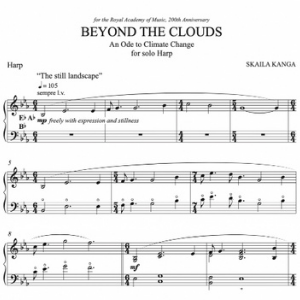
At the start of the year, I was asked by the Royal Academy of Music to write a piece for solo harp to commemorate the school’s 200th anniversary in 2022. I wanted to send a message through the harp about something really important that affects the whole world, so I chose climate change. Last December I recorded the music for Sir David Attenborough’s film A Life on our Planet, to which he came to Abbey Road and spoke to us all very movingly. In a spare moment on a session that month, I started to write some text which I hoped would inspire me to write the music. I completed the whole task by the end of February, and then suddenly in March we were completely locked down. At first it felt like a holiday for me, but then what? My instinct was to reach out to many friends and former students across the world to check they were all okay. Suddenly the idea that we could all collaborate in lockdown on this composition project was exciting. Over the next few weeks, harpists from around the world translated the narration for the piece—Beyond the Clouds—into 12 languages and the book was ready. On Jana Bouskova’s Facebook Harp Channel interview in June, the narration was read out by harpists in all the different languages. It felt as if we were holding hands across the world, totally moving and surreal.
Our passion and initial desire to play music is what will always carry us through life and its challenges. The healing power of music for us and for others is something irreplaceable. Stringent COVID restrictions and major setbacks for all artistic performances and education have been a huge challenge financially and mentally for the entire global musical community. But in time this will pass, albeit slowly, and the need for our contribution to people’s well-being will only grow. We have to be ready for that day with our practice, our projects, our creative ideas, and our artistry.
The world will need us more than ever. This much I know. •