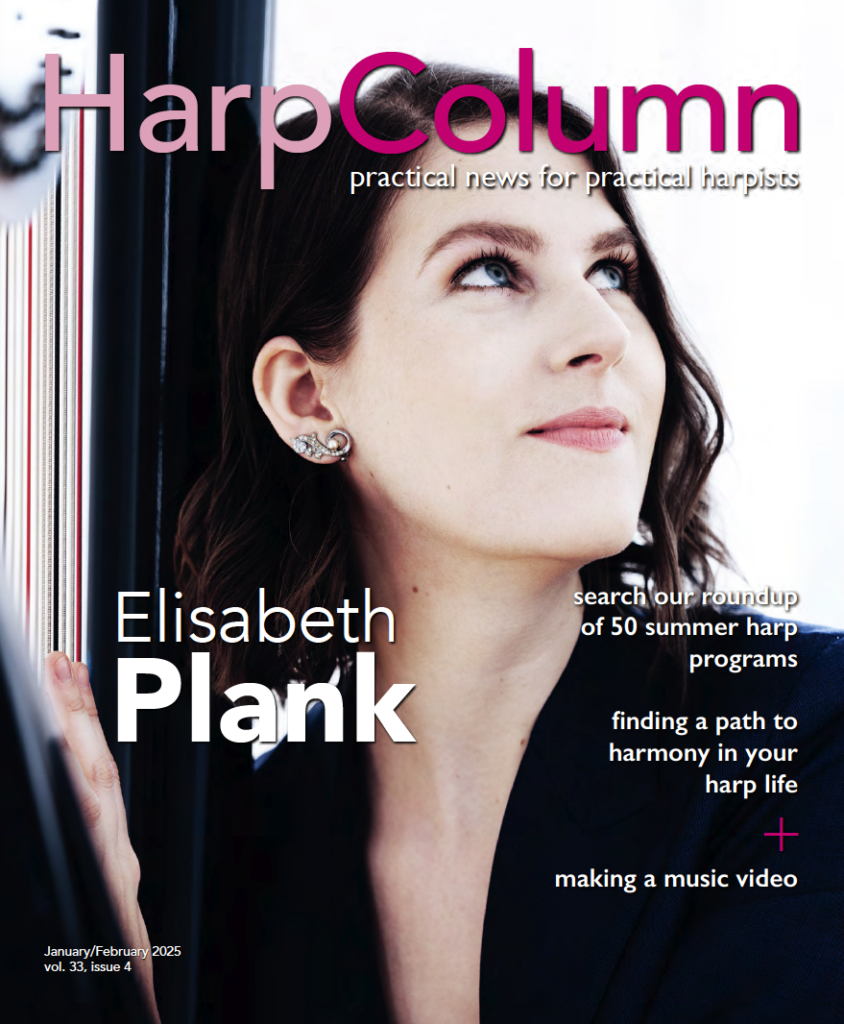


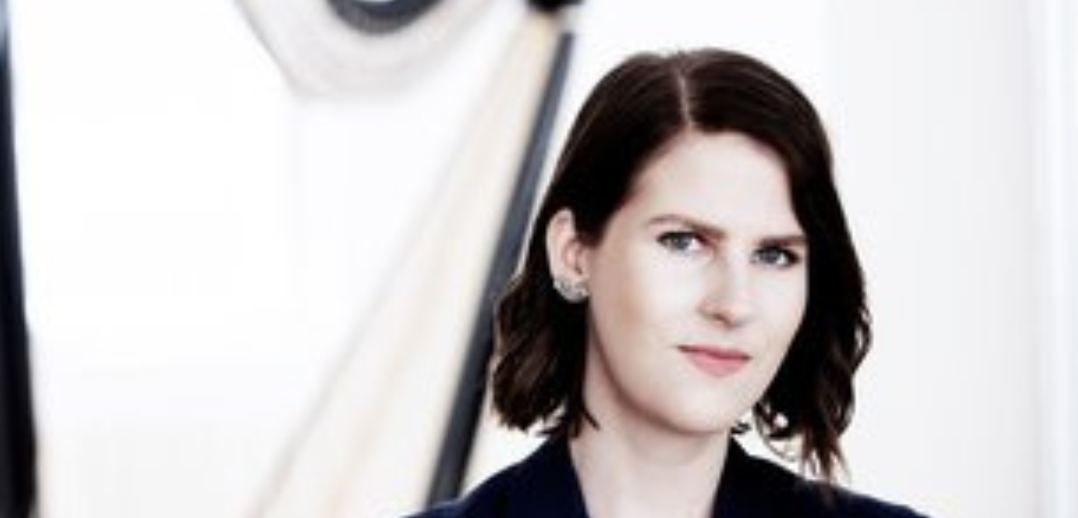
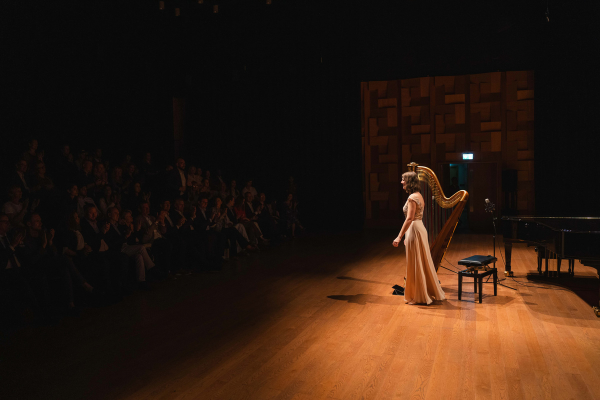
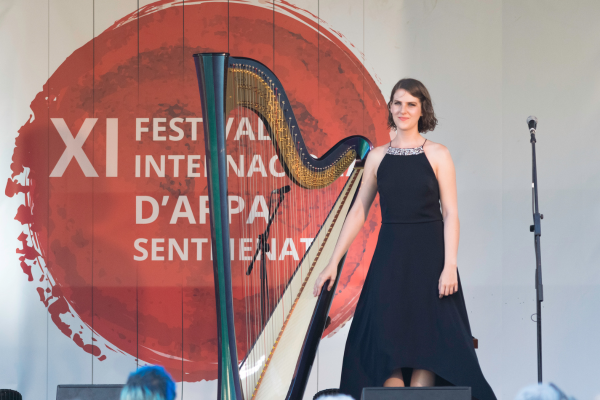
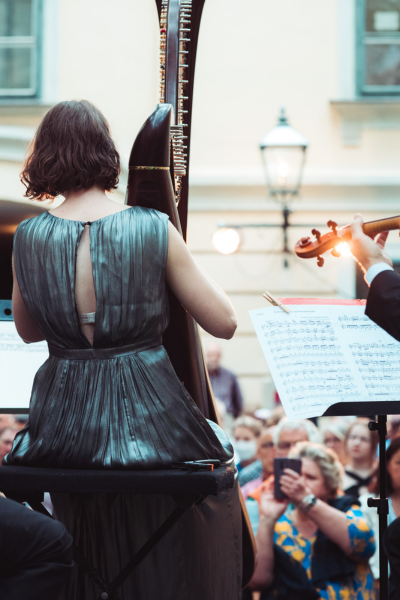
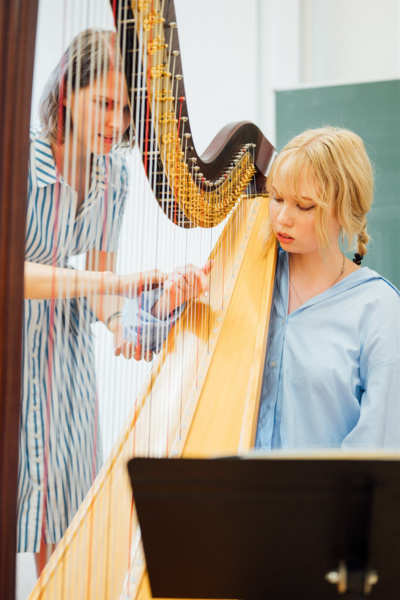
Many harpists are used to piecing together a career—a concert here, a teaching gig there, and pretty soon it adds up. Austrian harpist Elisabeth Plank is no stranger to that formula, having carved out a career as a soloist in one of the most competitive classical music scenes in the world—Vienna. An artist residency on the Wiener Konzerthaus’s “Great Talent” series from 2019–2021 helped Plank solidify her position as a prominent player in Europe and abroad. With an ever growing discography of harp standards and soon-to-be-released contemporary works, Plank continues to expand her reach to listeners around the world. We caught up with Plank to talk about what it’s like to be a soloist in 2025.
Harp column: How old were you when you decided that you were going to make the harp your career, and what did you think that career would look like at the time?
…I don’t want to look back at my life and ask, ‘What if?’ So I thought, okay, let’s try it and see what happens.
Elisabeth plank: Good question. I think the turning point was when I was 16. I have to circle back, because I started in the preparatory class at University of Music and Performing Arts Vienna when I was nine years old, and when I was 16, they introduced a new system with how the classes were grouped. Everyone up to age 16 would stay in the way that it was done before, and everyone after age 16 had to do a new entrance exam to join the new version of the preparatory class. So for the first time in my life, I had to do a new exam, and I also was at an age where I was consciously realizing what was going on. The first time, I was nine years old, and it was fun to play for some strangers and show that I can play the harp. But that time around was different. In the preparation process, I realized that it really meant something to me, and that I really wanted to get back in and to continue with harp. That helped me realize that it was serious for me, because until then, it was just something I did. I was not really sure if it was something I was aiming for career wise.
And so then I decided I really wanted to [become a harpist], but the only idea I had about being a harpist, or also being a musician, was to have an orchestra job. I had no idea that there were other ways. I had no idea about freelancing. I didn’t even dare to say I wanted to be a soloist, you know? So orchestra was what I was aiming for.
HC: How does your life now match that first dream?
EP: Not at all! It’s interesting that you asked that question, because my life doesn’t match that in many ways, because also, I had a kind of traumatic experience as a kid. My first teacher, she thought it would be a pedagogical fun idea to have me—someone playing harp for only a year—teach someone who just started out. But that kid really didn’t want to play the harp, and I got really frustrated and sad. I swore to myself I never wanted to teach. Yet here I am. I teach at a university, and I really enjoy it. And also, I’m a soloist, so I’m not in an orchestra, which is the thing I thought was the only option as a harpist.
HC: Did you ever take orchestra auditions or try to do that?
EP: Yes. It was a process for me to realize that I was only doing them because my professor at that time gave me the impression that it’s the only thing I should be doing. Or that when I played small concerts somewhere, that was just something for fun, but not something that I should aim for career wise. And so there was one audition that I took and I was in the finals, and I kept thinking, “Please give it to the other person.”
HC: [Laughs.] This is not the usual thought process.
EP: Yeah, and that was when I realized maybe this is not such a healthy thing to do, you know, to put myself through the process—it’s expensive, it’s stressful, it takes up a lot of time. From that moment on, I tried to [decide] if I should just go for it and try to make a career as a soloist and see what happens. I don’t want to look back at my life and ask, “What if?” So I thought, okay, let’s try it and see what happens.
HC: Give us a glimpse into a day in your life. What is a usual day like for you?
EP: The ideal day would be to practice in the morning, because then I know I have done the most important thing. Usually in the afternoon I do some emails and organizing things. Then it depends on the day, if I have to go to the university to teach. If I have more time to practice, I add some more practicing.
HC: Can you let us in on your secret—how does a harpist have a solo career in 2025? Because this is not particularly common. How do you make that happen?
EP: I think it’s mostly my stubbornness. Because when I finally manage to convince organizers that harp is a valid instrument for a solo recital and they book me for a concert, then there are organizers and audiences that want to hear even more harp. Because for the audience, it’s interesting to hear something else, and not to just go to piano recitals and hear the Beethoven sonata cycle for the umpteenth time.
HC: This leads into another question I had for you. When I go to your website and look at your review page, a common theme is that you have managed to break the traditional harpist mold, but yet the repertoire you play is about as traditional as it could be a lot of the time, right? So how do you make these older pieces sound new or different?
EP: It’s not necessarily about new or different [repertoire choices], it’s just that I don’t like to repeat myself. In terms of how we are as musicians, if we just do the same thing in terms of interpretation, if we just have one version and we keep doing that, then [it’s no different from] a CD player. I always try to embrace the moment in a concert and just go for it. Because the safe zone is the boring zone.
There’s a quote that was really inspiring for me by the late conductor Nikolaus Harnoncourt. He said that true art only happens at the brink of catastrophe. And I think that’s true, because if we react to the audience, if we realize we’re losing them because they are not into that specific piece, then maybe we push further, and suddenly they are back with us. Or [let’s say] you have to [play on] a harp that you are not really compatible with, so you try to go in a different direction that maybe you haven’t done in your own practice room. I think that’s when it stays real. That is what also speaks to people. They realize that, on a certain level, there’s something happening in the moment, and I’m not just there showing what I practiced at home. If that makes sense.
HC: Yeah, that’s really interesting.
EP: For me that was really a turning point, when I heard that quote. It made so much sense.
HC: Well, it’s funny that you just mentioned turning point, because my next question was to ask you, looking back on your career, do see any moment as being a turning point, or has it been more of a steady climb to get where you are now?
EP: Yes and no. I mean, of course, you build a reputation, and some things get easier, but then there’s always the element of surprise, or chances that you get, or things that turn out to be more important or have more of an impact than you thought they would have. I think it’s crucial that you realize quickly if something is worth pursuing, worth continuing, or if you should go in a different direction. For me, the most important factor was whether [an opportunity] was authentic for me. If I can stand behind it, if I feel good about it.
HC: You live in Vienna, which I’m a little familiar with, having visited many times, and I think many people would argue that this is possibly the music capital of the world. Has that made your career path easier or more difficult?
EP: What I’m really thankful for is the tradition at my university that interpretation is a core [principle]. It’s important in everything that we are taught—to try to understand the details, and then to create something out of that. So to put in your personal voice, but also really be [exact] with the text and not just “oh yeah, something, something and it will sound nice.” Because Vienna has such a rich tradition, but the harp is not one of those traditional instruments, it’s really hard as a harpist to be taken seriously. Most of the time when I get asked “What do you do for a living?”and I say, I’m a harpist, they ask me, “In which orchestra?” Okay, granted, that’s already kind of a good question, but still if I tell them, no, I play as a soloist, [they ask] “But how would that work?” [I say] it’s like the piano, they also don’t need [accompaniment]. It’s the same with concert venues. If you check their calendars, there’s not much harp if there is even harp at all, but there’s—I don’t know—30 different pianists per season, who sometimes even play the same thing. But that doesn’t seem to be a problem for some reason. So this conservatism—if that’s a word—in Vienna is an issue. But that’s also what Vienna is known for, that we’re very conservative, and the contemporary [music] scene is not that well respected either in the big halls. So it kind of goes together.
HC: Do you feel that you struggle to set yourself apart from all the other amazing musicians that must live there? Is it hard to make yourself stand out?
EP: It’s not really about setting [myself] apart. It’s about making them realize that we as harpists have the same worth as any other solo instrument or any other soloist. I don’t know if it’s about not wanting to try something new, or not wanting to dive into the repertoire to understand what we have, but they don’t even put us in the same level.
HC: So how did you learn to promote yourself in that kind of culture? How does somebody like you get booked on a solo concert series? How do you go about that?
EP: I would say I know the people that you need to know—the people from the venues who decide programming. Of course, it doesn’t mean that they will program me every season. But for example, a career program I was in, Great Talent (an initiative of Wiener Konzerthaus) was great because it was aimed towards young musicians, and they would present us in three or four concerts per season in different concert houses. Of course, that helps a lot, because if you can say “Great Talent” chose me—and not just in Austria, but in the big halls around the world—it means something to say that. I think it was a big help to have that [backing]. [I can say] “They already trust me, how about you trust me as well.”
HC: What kind of promotional strategy have you found to be the most effective? Do you have a plan? Is it something you think about years down the road, getting booked on a concert series?
EP: It’s hard, because even if I have a plan, it doesn’t mean they have the same plan. But of course if I have something coming up that maybe let’s say aligns with [an anniversary] of a composer, or I have a new recording or something like that, then it’s easier to get interest.
HC: You’re a fairly young performer, and you decided early on that you wanted this solo career. What advice would you give to other young performers? Especially today with streaming, the arts are not nearly as well respected as they were 50 years ago. So what recommendation would you give to a young performer trying to break into the scene that you’ve broken into?
EP: I think before you take any steps, you have to really understand if this is the life you want to live, because it’s not all fun and games. It can be the best and it can be the worst. That’s what I always tell people.
HC: In what way?
EP: Sometimes you have to work around the clock because you cannot decide your own schedule. Like when you’re on tour, you just have to do [the job]. Maybe you’re flying and playing the same day with jet lag, and no one cares. And so you shouldn’t care, because it’s your professional duty to just do your job, as harsh as that sounds. And of course, it shouldn’t be robotic. It should be musical, because people came to listen to you, so you should give something to them. So you have to have certain character traits to be able to be happy in that kind of life.
It’s not just about whether you are a talented musician. It’s about are you willing to maybe not have—let’s say—a normal life, or a more [typical] life working a nine to five job with weekends off. Maybe sometimes you have to prepare many programs in a short amount of time, and then you have nothing for a month, so you have to be strict with yourself, but also flexible.
And of course we have to be honest, especially nowadays, that the level has risen so much in any instrument. So you really have to have something—either excellency, or stress resistance, or you have to win something. And of course, that’s not even a guarantee. So there’s a huge portion of luck. There are so many more musicians than there were, let’s say, 50 years ago, where it was not easier, but just in numbers easier to make a living, plus changes in arts financing and changes in streaming and recording.
So I think before you embark on [this type of] career, you should be pretty sure that’s what you want to do, and then you have to give it your all. At the same time, you can’t just for it without considering how to proceed and without planning. I think it’s important that you find something that sparks your curiosity, your interest. So if you’re a fan of contemporary music, or if you want to go into improvisation, jazz, then you should follow that and not stay in the classical lane.
HC: So you gave us a lot of the challenges. Can you tell us some of the rewards that you have found in your career?
EP: I love that I get to experience so many countries and interact with so many different people, because as a tourist, you never get to experience a country that way. So that means that I might not be able to see all the sites, but I meet real people—if that makes sense—and that gives me energy and also inspiration for other concerts or other pieces.
Then, of course, it’s an absolute luxury to be able to do what you love to do. Because for me still—although sometimes I dream I [might] be able to have a nine-to-five office job—I think even in the office job, I would be more intense about it than another person. I just have to accept that I am this way, and that’s what makes me happy.
HC: Let’s talk about some of the things you have coming up. You have an album planned for 2025 that will be only contemporary premieres—how did you pick the pieces, and who are some of the composers?
EP: If it’s possible with a [concert] organizer—because sometimes it’s not—I always try to program at least one contemporary piece on a recital. In Europe, the separation of the [traditional] classical scene and the contemporary classical scene is very strict, so people might not even hear the other style if they don’t go to a concert specifically from that direction. With contemporary music, people are kind of afraid or worried to listen to it. So I think if you can just coax them into listening to something, they might be open to experiencing more.
Over the years I have collected pieces that composers have written for me. Most of the time, it was a [collaboration where] they sent me things, and I checked them and gave them feedback, so I was always very involved in the process to help to get the piece done. So for my new album, I decided it was the time in my career to make a recording of [these pieces], and I chose pieces that go together with the idea of identity—composers that come from different countries and how their upbringing or training reflects who they are today. Because as musicians, we always reflect our experiences; even if we only interpret, we also have roots in where we come from and how we hear things, or how our taste was created.
HC: Are the composers, people we’ve heard of before, or are they mostly people who have not composed for the harp?
EP: Most of them haven’t composed for harp before, but they are names outside the harp world.
HC: You’re also premiering two new concertos. That seems like a big deal—did somebody call you up and say, “Oh, we’d like you to premiere a concerto?”
EP: It’s kind of the bonus of working with composers intensely that most of them, before they started working with me, they were worried about composing for harp. “Oh no, pedals, so scary!” And then after they finished the piece they were always in love with the instrument and eager for more. Because of that, two of them said, “Oh, I want to compose a harp concerto, would you be interested?” I said, “Sure.” Why would you say no to that?
HC: How does that work when you don’t have an orchestra job? Will you be playing these with an orchestra or as a guest soloist with another orchestra, and will these be live performances in Vienna or someplace else?
EP: One of them, yes, and the other one will be premiered in Mexico.
HC: Well, you’ll have to let us know more about that when the time comes. In addition to performing, you also teach. You have a summer program—the Vienna Harp Days, and you also teach at a university. How many students do you have there?
EP: At MDW (University of Music and Performing Arts Vienna) I started as a teaching assistant to the professor, Mirjam Schröder.This academic year, I took over the orchestral/audition training, and I’m teaching the normal one-on-one lessons for harp. There are two harp classes. One is for the pedagogical route. In the Austrian system, when you want to teach at a music school, you need to have a certain degree, and you get that [by taking] that route. And then there’s the performance route, which is for orchestra, chamber music, contemporary, etc.
HC: Would somebody only be in one or the other, or could somebody be in both classes?
EP: You can do both. It’s tricky, but it’s possible. Some people do the teaching degree because you will [earn] more money if you have the teaching degree than if you only have the performance degree. In the performance class there are 14 students at the moment, and I am responsible for the orchestra excerpts and one-on-one lessons. I have to coach them for auditions, and also we do some work on the mental preparation process.
HC: Did Vienna Harp Days come as a result of your teaching job with the university?
EP: No, actually it was the other way around. So Vienna Harp Days kind of just happened. I had two people who were sent to me from the university professor to [help] prepare them for auditions. And those people asked me,”Do you give any masterclasses?” So many people asked me about it, I figured, okay, maybe I should give a master class, so I did a test run to see if it would work.
The story of how Vienna Harp Days was born had to do with lost hand luggage and a bus in Buenos Aires. I lost my hand luggage because I was forced to give it up on the flight to Buenos Aires, and everything was in there—my concert dress, my contact lenses, because you put the important things in your hand luggage, of course. I arrived the day before my concert and the organizers of Buenos Aires Harp Week had to take me to get contact lenses, and [other] things like that. So I was sitting on a bus with Guillermo Rehermann, the International Relations Coordinator of Buenos Aires Harp Week, and he asked me, “What are you doing this summer?” And I said, “I did this test masterclass, and it was really great.” He said, “You should do that again next year, and you should call it Vienna Harp Days.” So he kind of created it, and that’s how it started.
HC: And how many years have you done it?
EP: This year was our fifth edition. So next year, 2025, will be the sixth.
HC: I just have one more question for you. I’m sure the last few years of your life must have been really focused on getting your career off the ground—or maybe the last 10 years of your life. Now that it is, what’s next for you? Where do you want to go? Where do you see yourself 10 years from now?
EP: I think sometimes, especially during long tours or exhausting traveling, I keep thinking that maybe it would be nice to have a bigger teaching position where I could settle down more. But I think I just have to see what happens. Because so many things in my life that I’m actually happy about happen without any of my planning—or even against my initial plan—so I think I just have to be open for everything and see how it goes. •
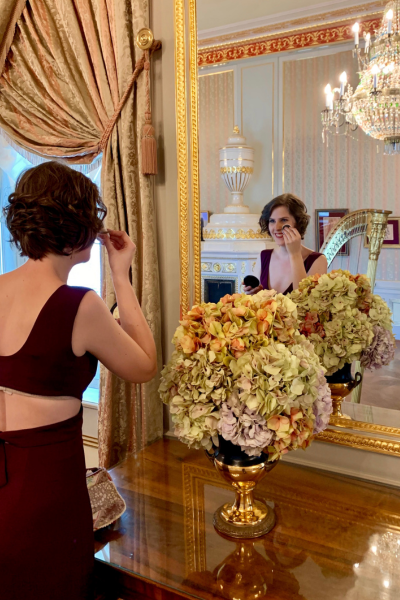
Everything about Elisabeth
Favorite Vienna cafe?
Prückel. It’s famous because it has a ’50s interior.
Espresso or filtered coffee?
Both.
Favorite vacation spot?
Italy.
Posse or Parish Alvars?
Parish Alvars.
Schnitzel or goulash?
Schnitzel.
Cats or dogs?
Cats.
Favorite piece to play?
A big favorite is always Hindemith Sonate or Ravel’s Introduction and Allegro.
Piece you’ve never played that you want to?
So many! Very high on my list are the Tournier Images.
Most inspiring harp recording that is not your own?
Is it terrible if I tell you that I don’t really listen to harp recordings?
Most beautiful concert hall you’ve ever performed in?
Oh, that’s hard. That’s mean. Let’s go with the one that has been most important for my career and that’s Wiener Konzerthaus.
Concert hall you haven’t played in yet, that would be your dream?
So many! [Laughs] Elbephilharmonie.
Job you’d want if you were not a harpist?
Archaeologist. It was the other thing that fascinated me as a child. But it’s the same [kind of] ridiculousness, I guess. It’s not a normal thing to do, and I guess equally as hard to have a proper job in that field.