

7/10
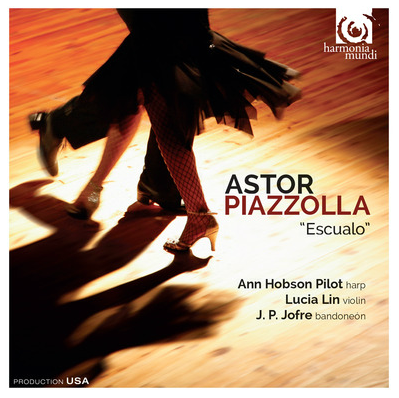
Ann Hobson Pilot, harp, Lucia Lin, violin, and J.P. Jofre, bandoneon, Harmonia Mundi, 2015.
It seems every artist comes to a point in their career when they discover Argentina and specifically the tango. Hey, even I spent several months teaching and playing in this unusual melting pot of a country and recorded a testament to those heady days. But that was 20 years ago. It now seems like a well-tread territory to look at the greatest re-creator of tango, Astor Piazzolla, in a new light. Can we hear anything nuevo in nuevo tango? Well, it seems we can, as harpist Ann Hobson Pilot, along with friends violinist Lucia Lin and bandoneist J.P. Jofre, prove so elegantly.
We hear harp by the second bar of music in a guise, perhaps as menacing as the one created by John Williams, as Piazzolla’s Escualo—shark—swims into our speakers with nary a warning. Lin and Jofre wail away in tandem, with Pilot looking on from shore. Repetition, intensity, and a slow burn are hallmarks of Piazzolla. Performers can find themselves lost in the energy, building too fast with nowhere to go. The ensemble is united, but the frantic feeling jars.
The energy retreats in Piazzolla’s masterful cinematic narrative of his national dance Histoire du Tango. In “Café 1930,” duo violin and harp take us to a melancholic smoke-filled yesterday. The faces are hidden in shadow, only lithe bodies are in focus, entwined impossibly close and pressed in movement about the floor. However, the harp felt large to me, the resonance too much for the space. While a perfect accompanist, I somehow felt Pilot was uncommitted as a full-fledged participant.
In the short and almost unknown piano work Valsisimo, we enter back into the nostalgia of times gone by and the true motivation behind Piazzolla’s obsession with tango as not for the feet, but for the stage. His music is more about memory than anything else and it is in these slow, heavier moments the recording is at its best. Beautifully arranged by one of Pilot’s former students, Michael Maganuco, the harp is given more space to breathe and expand, though I found the placement of microphones did not always do the ensemble justice. The room felt too alive, which gave far too bright a glare to the violin—almost to the point of brittleness—and a duller patina to the harp, keeping it just beyond the spotlight. This became sadly evident in Lin’s solo performance of Tango-Étude No. 3. Given the command to play “Molto marcato e energico,” we heard too strident a tone without its luster.
The song “Chiquilin de Bachin” ushers us into the rougher side of Buenos Aires nightlife where those having danced most of the night walk quickly to a favorite restaurant barely noticing the grubby homeless boy selling roses. Again the arrangement is moving, the use of harmonics on the harp at just the right moment is heart-rending. But there are unusual and unexpected chords, where I wanted Pilot to take more time as if we notice the boy for a brief second before moving on in this exotic locale which could be anywhere.
What was most successful was the final trio of works, Piazzolla’s Ángel Suite. Jofre’s bandoneon returns with a lusty sound, Pilot’s accompaniment is his breath and heartbeat, and Lin’s tone is sensuous and full of rapture. La Muerte del Angel is all expressive angst, with finally the Resurección leading tenderly—but inexorably—to a satisfying climax. Pilot’s solo in this final track is the highlight of the entire CD. •