

Forum Replies Created
-
AuthorPosts
-
evolene_t
ParticipantThank you Gretchen for this recommendation. Do you have any link to a video or audio where we could hear a good version of this?
Thanks!ParticipantGreat advice, Im taking good note!
However, I’ve also heard that it was a bad idea to buy all of the strings in bulk. The reason being that people tend to replace 5 or 10 years-old strings… with other 5 or 10 years-old strings, that risk breaking just as quickly, and that haven’t been correctly conserved. Better to buy the correct sting at the time when it is needed.What do you think?
ParticipantThat you for your answer, wil-weten!
I actually went straight to the Dusty Strings forum to ask there. Christy from the Dusty String Team answered that although they haven’t done any long-term testing, their double-strung harps are designed to handle extra tension so it should be fine.
Quite a relief!However, if anyone has any input as a maker, or previous experience as double-strung harp owner, don’t hesitate to contribute!
(I’ll add that I waited a few years before deciding on this type of harp, consulting as much of the literature on the subset as I could find. Seeing how that’s relatively little, it falls upon us to create that knowledge… And that’s one piece of it!)
ParticipantThank you for the info!
ParticipantHello again!
I’m back for an update on the new harp.
To answer you guys in disorder :
– No, I’ve never heard of the other names of bubinga. Then again, I’m not a specialist in wood types.– Concerning the Laurie Riley video, it would be better to say that I’m re-re-re-re-watching it in full. I’m always amazed at how easy to understand it is. Plus, I’ve shown the part where Laurie plays a melody on a single-strung, then on the double-strung, showing the possibilities, to many people.
On a more general note :
The harp still need tuning once or twice a day, and the 3 last strings are consistently lower than the others by the same notes. Nothing to be concerned about, the harp still feels so new.
Today, the big event was my first lesson with my teacher who came by my house to see the harp directly for herself. Because of the holidays, we did an especially long lesson and a lot of time was spent just talking about the possibilities of the harp and her trying it out. She’ll recommend a friend of hers specialized in medieval music, that plays the type of harp Simon Capp (seen above) designs. She had trained for a while on this style but favored the “normal” Celtic harps in the end.
Anyhow, she felt renting this harp was a great idea and opportunity. And BTW, it also was the first time that she played with this kind of double-harp.Again, this is a typically American model, from what I understand : from the people who ordered it (Riley and Kollé?) to the makers (Stoney End, Ree’s and Dusty Strings). That’s a market that the French haven’t explored, apparently.
As confirmed, tension is great, the sound is beautiful (we both agree) and the soundbox is loud and strong.
My teacher was surprised at how far-spaced the two row of strings were from one another (about 5cm – 2 inches), which makes it confusing to the eye. However, the spacing between the strings are standard, even if they are less wide than the Camac’s.Playing for me is getting smoother and smoother. Of course, I’m not advanced to begin with, so it’s easier to reach my beginner lever on a different harp.
As well as Laurie Riley, I’m steadily following Carolyn Deal/Smilingharp’s YouTube videos. Now, I’ve only had the harp for 3 days, and with work I’m practicing slowly.
At the moment, I’ve only gone through Waterfalls, Cascades, and starting on 1-5-8´s (for those who saw the videos and know what I’m referring to). It’s still clunky but I’m truly enjoying myself.The next step will be to buy Laurie Riley and Beth Kollé’s books about the Double-Strung, but I’m taking it one step at a time. Too much of a good thing…
On the other hand, I’ll be buried in work in September and October so I’m just enjoying myself now.So that’s it for this time! I’ll keep you updated when I can 🙂
ParticipantI’ll use this thread to ask another, related, question : I see some users (like you, Elizabeth) have a profile image, while others (such as Jordan) do not.
How does one add a profile image? Do you have to subscribe to (and pay for) Harpcolumn magazine?Thanks!
ParticipantThank you again Biagio for all of these informations.
So it is bubinga wood : interesting, I’ve never hear of it. I looked up the term in french and it doesn’t come up (it says on the Dusty String website that some countries have an issue with it at customs, because it is rare, exotic wood). Very interesting!I’ll keep you updated about my journey with the double-strung. Right now, I’m loving it 🙂
August 24, 2017 at 6:37 pm in reply to: Is there a way to strap my Dusty Strings to my chest and play it while standing? #209430ParticipantHello Anna,
It’s been a few month since you posted this, and I was wondering if you had found a solution? I am renting the same harp, only in double-strung.
The only thing I’ve found is not a strap or harness, and you wouldn’t be able to play this FH26 standing up. However, it might change the way you sit down. I’m talking about the harpsicle stick featured in Laurie Riley’s video about double-strung harps (about min 7 on the Youtube video).
This is what she’s talking about :

And you can find more infos here : Harpsicle Stick – Harpsicle-Harp.com
Hope that can help! But if you find the strap solution, I’m definitely interested in hearing about that.
ParticipantHello all,
Thank you for you replies and your interest. I am, of course, still getting used to the harp. Tuning it takes quite a bit of time (there are “forty-twelve strings”, after all, like my boyfriend says). Since it is almost new, the last few strings slide out of note rather quickly, but the rest holds up.
Like you said, Wil-Weten, it had apparently been rented before but it still very much feels like a brand new harp. I think the previous owner only kept it for a couple of months.I actually still have the Camac Hermine 34 strings that my teacher is renting me (I’ll try to include pictures in my message) :
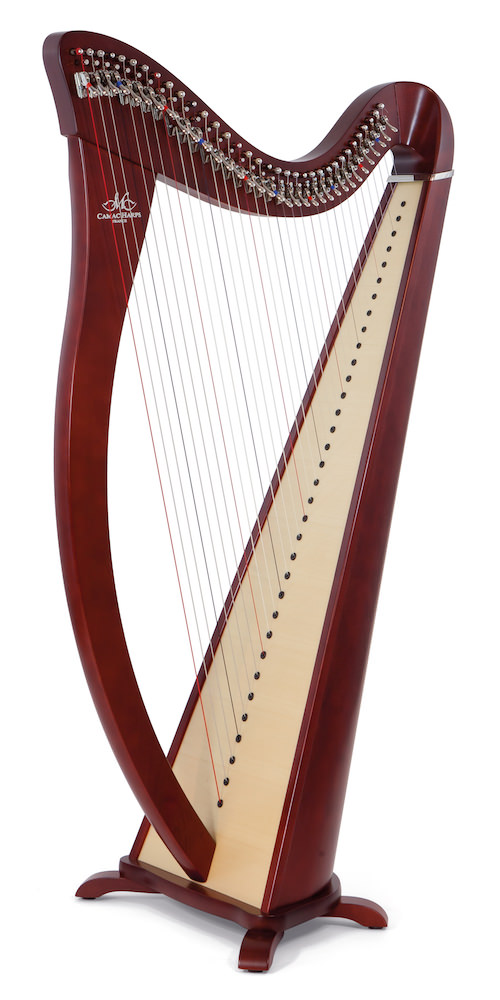
This enables me to give you a true side-by-side comparison. I’ll also try to remember how it was with the first harp I rented, a Camac Bardic 27 strings of the “troubadour” type.
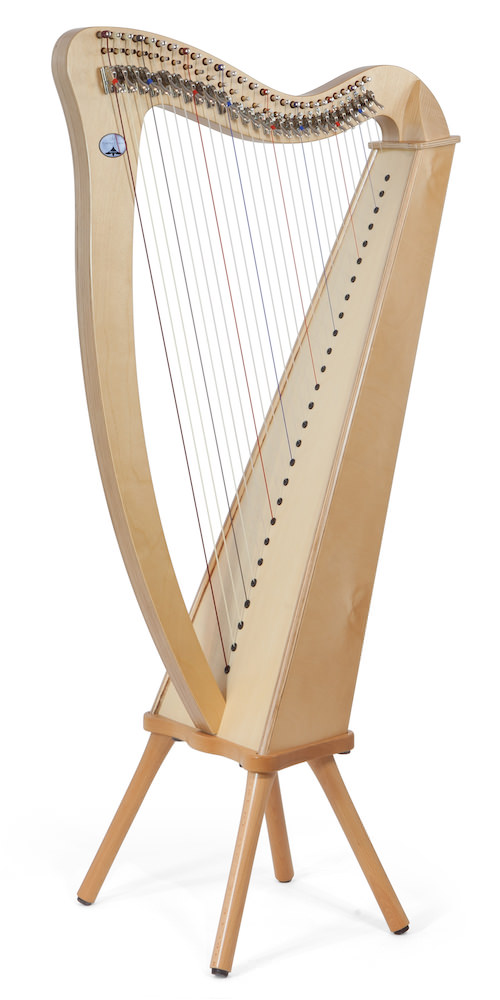
And, of course, this is the model I have :

String tension and sound :
First, my main fear was soothed : as you know, my teacher told me double harps have very loose strings, hard to play with. I can safely say, with the Camac Hermine by its side, that the string tension is the same (for the mid- and upper strings, of course) for both harps. There’s a relief! (And also the reason I needed to try it out in the shop).
Both harps have nylon strings, that are more flexible that the gut strings with which my teacher plays. Of course, nylon and gut have two different sounds but I’m always very pleasantly surprised with nylon : I expect a “plastic” sound and yet it always makes me shiver with pleasure.
The sound is, indeed, very nice on the Dusty Double : a very clear sound.
Size
Now, of course the most apparent difference is with the size of the harps : the Camac Hermine truly is a “harpe de salon“, an instrument that you expose in a living-room and move around of. A good part of what attracted me towards the double-strung is the possibility to have a harp that can be carried around (ex : to play outside in the woods) whilst not sacrificing range.
And this is definitely true : now, I have carried it from the shop back home, and although the bag-case it very well-made, I don’t think I can go hiking with the harp 😉 Like the Camac Bardic 27, it starts weighing after a while.The small size of this Dusty harp also makes it strangely cute : men in my house themselves have used the term (and that’s not a common thing for them to say :-D).
Plus, I really love the deep wood colour. So overall, the appearance is definitely striking.String spacing :
That was the next things that hit me when I started playing : I thought I was still trying to find the strings “through” the other row, but it turns out that what confused me was actually the fact that the strings are closer together. In fact I wouldn’t recommend this harp for someone with big hands.
To give you an idea, playing with the Camac Hermine, I sometimes have trouble playing arpeggios, especially with my left hand, and specifically with the 4th finger. The strings seem just a tiny bit too far apart. I’ve not once had this issue with the Dusty!Seeing the strings
Like you say, Biagio, two rows of strings presents a new challenge. I had already braced myself for the difficulty of seeing through two rows. The left hand plays fine, but for the right hand I have to compose with various things
– First, playing “higher up” or closer to my shoulder, since this is a smaller harp
– Not being able to perceive the strings as well. I try to rely on the colours, by just focusing on one colour-string ; and I also try to play less with my eyes and more in the “feeling”. I was aiming for that anyhow. After all, the trope of the Blind Bard playing his celtic harp is a strong one. You don’t need to actually see if you know what your hands are doing.
– The separation : obviously, there is a gap between the left and the right hand. They don’t play on the same plane. That still takes a little while.However, I was expecting it to be blurry. The testimonies I could read here and there all said that people found it very hard to focus. This was actually a problem for me when I moved from the Camac Bardic to the Camac Hermine (again, the string spacing probably plays a role there). But the strings are not blurry ; they’re just “not quite there, oops”. I’m confident I’ll get over it quite fast.
The Sound
One element that definitely surprises me is the sound that little harp can bring forth. Is it just, like Biagio said, that the strings ring in unison?
I think the soundbox plays a lot there, and I had read some time ago on the Dusty String forum that the FH26, when in walnut, has a very deep sound.
I just checked the Dusty String website : the harp I am renting is in Bubinga, I believe? The soundboard, as you can see pictured above, is in wood of a lighter colour.
Anyhow, I am having fun comparing the loudest sound I can bring out of the Camac and the Dusty and I can definitely say they are almost equivalent (perhaps the Dusty is a bit quieter on the lower strings, but it is hard to tell).So, if I compare to the “troubadour” Camac Bardic 27 strings, this Dusty Double plays louder.
The comfort
Now, one of the reason my teacher had me move quickly from the Camac Bardic to the Camac Hermine was because of posture : she wanted me to learn the correct posture at the harp, fearing that a smaller harp would make me hunch over.
Another issue was that on a floor harp, the right hand rests comfortably on the harp and you only have to hold up the left arm. But on smaller harps, one can’t rest the forearm as easily.
Now, those issues are neither specific to double-strung harps, not to this Dusty String in any way. I’m just commenting on the differences.One thing that is linked to this harp, though, is the small issue I’ve encountered with the edge of the harp that rests on my shoulder. Compared to the Camac Hermine, which is rounded, this one has a small angle which can be felt on the clavicle/collarbone. Wood against bone, although not exactly painful, doesn’t feel that great. Anyone have this issue?
I’ll take the time needed to get used to it ad update you in a few weeks or months, about that.So now I’ve “troubleshooted” the harp, all there’s left is to practice, practice practice!
I’ll show the harp at the end of the week to my teacher, and will be very interested in what she has to say.Thank you all, again!
ParticipantHello all!
I am posting an excited update to this post : I have been able to find what was probably the only double-strung harp in France.
The seller was Le Magasin de la Harpe (or Harpe Budin, from the name of the owner).
They are actually resellers of Dusty String harps as well has Camac, Salvi and
other brands, and are very well known in France.
They had a single model, just arrived, of the FH26 double-strung by Dusty String, that I rushed to try out.
I love the model, and am currently renting it with possibility of buying out the harp if I’m pleased with it.After we signed the contract, ( => he was just chitchatting, not trying to push the sale) the seller told me there were a few people that had been very interested, including someone that very morning, but that I was the only one that went out to rent it straight off. Since they don’t plan on ordering another model soon, any further sale would have to be custom.
He was quite surprised to see that a few people were interested : he himself seemed bewildered by the thing, telling me it might serve to play jazz…He was very open however, when we chatted a little bit. He saw all of the opportunities that the double-strung offered. That very harp has apparently been rented out by a long-time harp player, who liked the concept but gave it back as he wasn’t sold by it and found it too confusing, too “new”.
As for me, I have yet to spend a few hours on it and tell you how I feel about it.
In the meanwhile, if anyone has tried this double-strung, I would love to read a write-up/debriefing. Especially if you have tried out other double-strung harps 🙂
Thank you all!
ParticipantIndeed Biagio, I think you are right and this is what my teacher was referring to! She admitted herself not knowing much about double-strung harps as they were, in her eye, only for those who wishes to specialise in Medieval music. The told me that she could refer me to a teacher that does seminars in France, but, again, these harps are too “loose” in her eyes.
There are a lot of people in France that specialise in medieval culture (I think in the US you have “Renaissance Fairs” though they don’t relate to the same time period).
But if one wishes to play “standard harps”, either classical pedal harps, or smaller celtic ones, it is much harder to find a harp that deviates from the models already in place. Then again, playing the harp is in itself rather a niche instrument (unlike guitar or piano), so that explains why.ParticipantHello Elettaria,
My heart always pinches when I read that you cannot sit up at the moment (though I confort to think that the cat is the main culprit for that ;-))I know little about the Reverie and I agree that the price is quite high for a range that might not be enough.
The lyres on the other hand look beautiful. But watching the video, I realise that the player lays the lyre flat on his knees, unlike the harp which one holds vertically.—–
In this case, you might also want to look into the instrument called Psaltry (psaltérion in French). Also called “lap harp”, they are not to be confused with Dulcimers where you strike the strings with a small hammer, or Bowed Psaltries that look medieval but are actually quite a recent invention and that are played with a . After a quick search, the website “Song of the Wood” have the models that I mean.
Song of the WoodI bought one for myself, hoping that it could help me practice the harp. Mine is wire strung and it cost about 70€ for a sound that is really beautiful. They generally have 12 to 15 strings. Sometime the makers make the strings double, in a way that looks like the dulcimer.
Here’s a french website where the person makes his own medieval instruments : Atelier de ClaudeThe great thing about psaltries is that you can basically hold them any way you like : flat on your knees or your torso if you’re lying down, smaller strings side up or bigger strings, or even vertically like a harp.
Here is a video in a French castle where someone recreated, then improvised on a Psaltry, if you want a look at the instrument : Psaltérion de Puivert
Depending on the size it’s about the size of a computer laptop, or smaller, and weights less than a kilo (or 2 pounds).However, the catch with all of the instruments that we mentioned in this thread is that you cannot play with both hands on each side, which is what the harp allows. But the same can be said for the lyre. You can also tune the psaltry any way you like (no levers though), both diatonically or pentatonically. Personally I like to experiment with both.
You can strum the strings and use a guitar pick for that, or just the fingers.—
Now this is not to say that the lyre isn’t the best choice for you, Elettaria. Unfortunately I also can’t advise you on wood choices and the likes. This post is more to give a introduction to this little-know European medieval instrument. Perhaps you might look into it!
ParticipantThank you Elletaria for the link to Simon Capp : however, i tend to be wary since he talks of “arpa doble” : since the double-strung is, as noted earlier, not yet well-know, I’m afraid this could be a cross-strung harp instead. This is often what I find, sold as “double harps”.
The price range though is very affordable so I’ll look into that and keep you informed 🙂
ParticipantThank you for that piece of history. I realise, even in France, that the practionners of Celtic harp are much fewer than I though. Although I grew up hearing it in Britanny, not that many people actually play it. Of course Alan Stivell is the main reference here and has inspired many others.
On the other hand, people also practice the pedal harp in the classical range. But on that end there is the very real limitation that comes with the price range of that instrument.
Thanks to your advice I will definitely start practicing those double techniques that could be applicable on the single. Being an absolute beginner I’m struggling with absolute beginner stuff such as finger placing ^^ it will come soon enough!
ParticipantThank you again for your advice!
Elettaria, I too have mailed Stoney End and found them wonderfully quick and nice to chat with. Their price list still contained the Anne harp as a double-strung but they told me that the choice now was between the Britanny as a lap harp, of the Lorrain as a floor harp. As for the kit part, which would considerably have reduced the cost, Gary Stone advised me to get help from a luthier as a beginner in woodwork, it would have been too great a task.
Which leads me to you advice, Biagio. I’m impressed, eight harps does seem to be quite an investment! But I think you are right to remind me not to get fixated on one and only harp. Thank you for pointing out that the Rees’s also made double-strung, by the way, I strolled right past that when checking out their website!
If you think it’s a good plan to first learn on a little harp, then on a normal 34 strings before investing in a double, I think this is probably what I will do. After all, I get very excited but I know how to take my time (I’ve been looking at these double harps for nearly two years, now that I think of it, and taking harp lessons for only one). If it enables me to access the second-hand market, all the better! (Although in Europe, this type of harp seems strangely unknown, even experienced harpists confuse it with the cross-strung all the time).
Though I must say I never considered a cardboard harp, that might be the perfect compromise! It is extremely cheap for a harp and I could both develop my feel for the double, and not be afraid to travel with it. Since you recommended it I will look into this Blevins 🙂 Thank you for the tip!
Again, wonderful advice that I keep in mind 🙂 Thanks again!
-
AuthorPosts